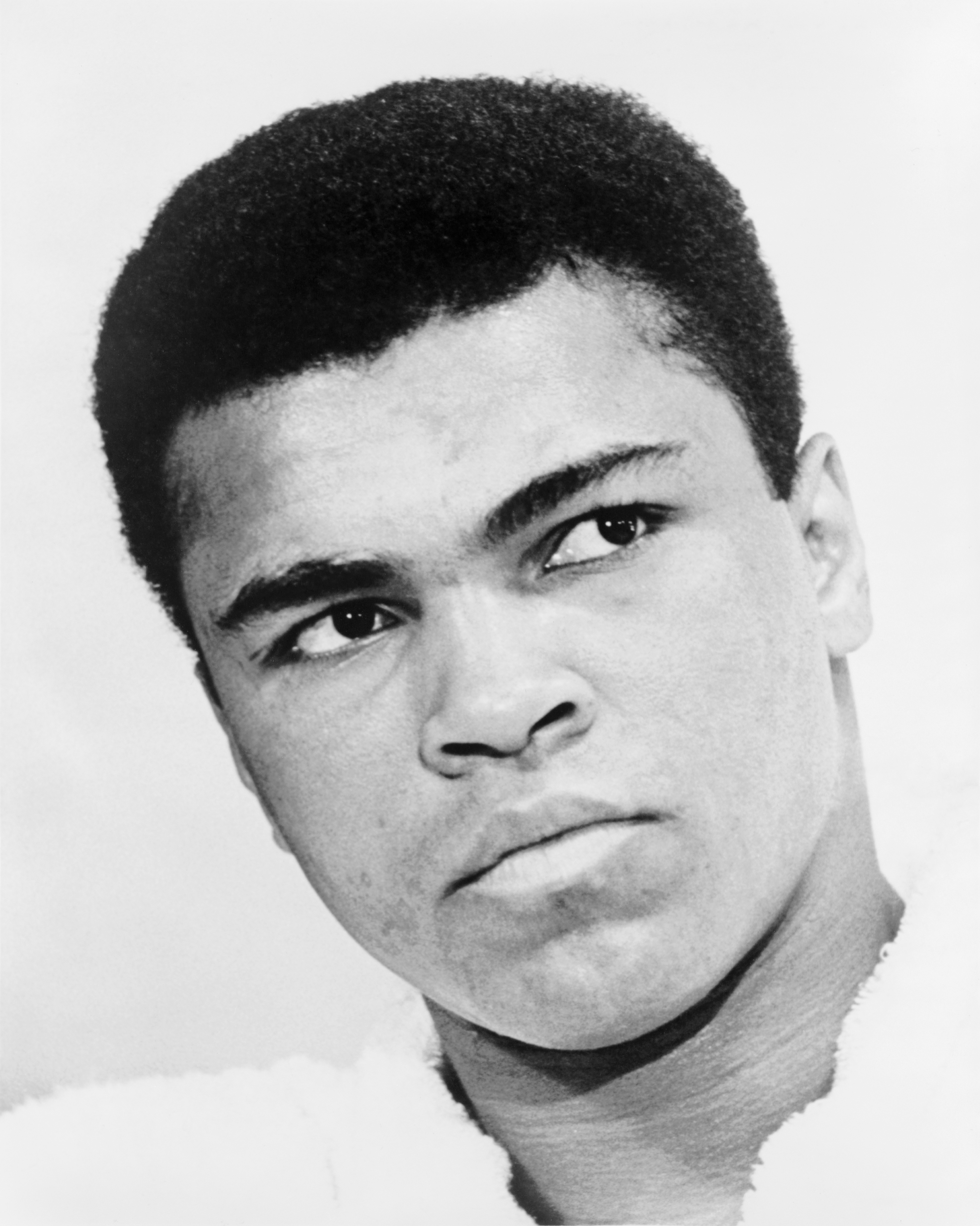
Muhammad Ali
Boxer and social activist
of 100 · stable trend · Strong moral/spiritual alignment
Standing
82/100
Raw Score
71/85
Confidence
74%
Evidence
Strong
About
Muhammad Ali combined elite athletic fame with unusual public risk-taking for faith, peace, racial justice, and humanitarian causes across several decades.
His observable record shows repeated service to vulnerable people and unusual steadiness under pressure, with real concerns around some early Nation of Islam rhetoric and a more uneven private-family record.
Five Pillars
Pillar scores (0–100%)
Ali's public record is unusually strong on courageous witness and concrete service to vulnerable strangers. The main reasons the score stops short of exemplary are early divisive rhetoric, a less reliable public record around private-family obligations, and limited direct visibility into daily worship beyond broad Muslim self-identification and later public faith witness.
Goodness over time
Starts at 100 at birth, natural decay after accountability age, timeline events adjust the trajectory.
17 Criteria Scores
Individual item scores (0–5) with evidence notes
Core Worldview
Public Muslim identity and lifelong God-language were explicit.
Scored with Muslim assumption-of-best absent contrary evidence.
Scored with Muslim assumption-of-best and repeated public faith references.
Ali repeatedly framed life through religious guidance.
Scored with Muslim assumption-of-best absent meaningful contrary evidence.
Contribution to Others
Public evidence exists but is much thinner and more mixed on family obligations than on public service.
Repeated hospital, youth, and school-facing humanitarian work.
Multiple documented aid and relief missions targeted materially vulnerable people.
Hostage diplomacy and cross-border goodwill missions show repeated help to stranded strangers.
Public record supports responsiveness, though not always with direct requester evidence.
He took visible part in anti-apartheid advocacy, prisoner/hostage efforts, and rights-focused causes.
Personal Discipline
Public Muslim identity plus assumption-of-best; some public worship evidence exists.
Public charitable giving was strong, though specifically obligatory giving was not richly documented.
Reliability
Public courage was strong, but early rhetoric and more uneven private-life trust signals keep this score moderate.
Stability Under Pressure
He endured lost prime earnings during his boxing exile, though the public record is not chiefly about prolonged poverty.
Late-life illness was met with steady public service and patience.
Draft refusal and crisis-zone diplomacy were unusually high-cost pressure tests.
Timeline
Key events and documented turning points
Wins the heavyweight title and publicly takes the name Muhammad Ali
After defeating Sonny Liston, Ali publicly embraced the Nation of Islam and took the name Muhammad Ali, making a costly and highly visible religious commitment rather than staying culturally safer as Cassius Clay.
→ This fixed faith identity at the center of his public life and made religion a lasting part of his social witness.
highEarly Nation of Islam-era rhetoric drew backlash
While Ali was widely remembered as generous in person, press coverage during his early Nation of Islam years often framed him as racially divisive, reflecting a real period where his public message was sharper and less universally trustworthy than his later stance.
→ This remains a real blemish in his public record, though later decades showed broader and more conciliatory public conduct.
mediumRefuses Vietnam draft and loses his title
Ali refused induction into the U.S. Army at the height of the Vietnam War, citing religious belief and conscience, and then lost his title, boxing license, and prime earning years while fighting the case.
→ The stand became one of the clearest public examples of principled resilience in modern sports history after his conviction was later overturned.
highUses his fame in the U.N. campaign against apartheid
Ali addressed the United Nations Special Committee against Apartheid and kept attaching his celebrity to racial justice causes outside the ring.
→ This reinforced a repeated pattern of using fame for public advocacy rather than only personal brand-building.
highHelps secure release of hostages in Iraq
On the eve of the Gulf War, Ali traveled to Baghdad and helped free 15 U.S. and British hostages whom Saddam Hussein had used as human shields.
→ This became one of his clearest acts of direct help to trapped strangers under international crisis pressure.
highTurns Parkinson's disease into a public service platform
After years living with Parkinson's disease, Ali helped attach his name and public energy to long-term patient care, education, and support programs that continue through the Muhammad Ali Parkinson Center.
→ Late-life weakness became a visible channel for service, patience, and practical help to others facing chronic illness.
highVisits Ground Zero and publicly defends Islam as a religion of peace
Nine days after the September 11 attacks, Ali went to Ground Zero, comforted workers and first responders, and publicly rejected terrorism done in Islam's name.
→ He used his credibility to reduce fear and draw a moral distinction between Islam and mass violence during a volatile moment.
highVisits Afghanistan as a U.N. Messenger of Peace
Ali traveled on a three-day goodwill mission to Afghanistan organized with UNICEF and the World Food Programme, visited a co-ed school and women's bakery project, and urged young Afghans to combine faith, education, and discipline.
→ The visit extended his pattern of taking personal visibility into hard places on behalf of vulnerable populations.
highPressure Tests
Behavior under crisis or scrutiny
Vietnam draft refusal
1967Ali lost his title, license, and prime earning years after refusing military induction.
Response: He held to his stated religious and moral position through legal defeat and public backlash.
strong_positiveParkinson's disease
1984A debilitating neurological disease steadily reduced his speech and movement.
Response: He remained publicly present for patient care, awareness, and humanitarian appearances rather than withdrawing completely.
positivePost-9/11 anti-Muslim climate
2001Islam was publicly associated with terrorism after the September 11 attacks.
Response: Ali publicly condemned the attacks, visited Ground Zero, and defended Islam as a religion of peace.
strong_positiveProgression
crisis years
Illness reduced his physical powers, but the public meaning of his life shifted toward patience, mercy, and service.
stabilizingcurrent stage
As a deceased public figure, his legacy is historically stable: morally impressive overall, but not without real complications.
stableearly years
A gifted, disciplined athlete from a segregated America became publicly religious and politically confrontational very early.
upwardgrowth years
Public courage widened into transnational activism and humanitarian travel, though traces of early ideological sharpness remained.
upwardBehavioral Patterns
Positive
- • High-cost moral stands under pressure
- • Repeated direct help to strangers in crisis
- • Publicly identified faith linked to service
Concerns
- • Early divisive rhetoric
- • Mixed observability around family follow-through
- • Later reputation can overshadow earlier contradictions
Evidence Quality
6
Strong
3
Medium
1
Weak
Overall: strong
This profile measures observable public behavior and evidence, not hidden intention, private repentance, or salvation.