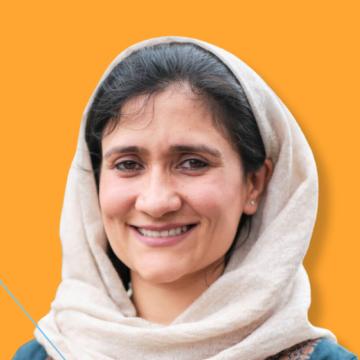
Shabana Basij-Rasikh
Afghan educator, founder of SOLA, and advocate for girls' education
of 100 · improving trend · Strong moral/spiritual alignment
Standing
76/100
Raw Score
65/85
Confidence
68%
Evidence
Strong
About
Basij-Rasikh's observable record is strongest where danger, exclusion, and girls' education meet: secret schooling as a child, institution-building as an adult, and rapid protective action when Taliban rule returned.
The public evidence supports a strongly positive profile on social care, integrity, and resilience, with thinner direct visibility into private worship routine and family-level obligations.
Five Pillars
Pillar scores (0–100%)
Her public pattern is unusually coherent: she risks, builds, protects, and keeps going. The strongest evidence is for social care and resilience, while private worship and family-specific duties remain less observable.
Goodness over time
Starts at 100 at birth, natural decay after accountability age, timeline events adjust the trajectory.
17 Criteria Scores
Individual item scores (0–5) with evidence notes
Core Worldview
Contribution to Others
Personal Discipline
Reliability
Stability Under Pressure
Timeline
Key events and documented turning points
Attended secret schools in Kabul after the Taliban banned girls' education
As a child, Basij-Rasikh disguised herself as a boy so she could accompany her older sister to underground classes, building an early pattern of taking real risk for learning rather than surrendering to coercion.
→ This experience became the moral and practical foundation for her later work to make girls' education safer and more durable.
mediumCo-founded the School of Leadership, Afghanistan while at Middlebury College
Instead of treating her education abroad as a personal escape, Basij-Rasikh helped launch SOLA in 2008 with the explicit mission of expanding quality education for Afghan girls.
→ Her student initiative became the organizing commitment of her adult public life.
highOpened SOLA's Kabul boarding campus for the first class of 24 girls
SOLA moved from aspiration to a functioning Afghan-led boarding school, designed so girls from different provinces could study safely, learn English and Quran, and build cross-ethnic sisterhood.
→ A concrete institution replaced rhetoric, proving she could deliver protection, education, and long-horizon leadership development.
highProtected students by destroying school records and evacuating the SOLA community to Rwanda
After Kabul fell, Basij-Rasikh and Afghan staff burned student records to shield families and helped move nearly 250 community members, including more than 100 girls, out of Afghanistan before resuming classes in Rwanda four days later.
→ She converted crisis response into continuity of care, preserving lives and the school's mission under extreme pressure.
highExpanded access through SOLAx and public admissions outreach during exile
Basij-Rasikh used SOLA's official blog to show that 3,290 girls applied in the 2024 admissions cycle for roughly 30 seats, while also directing applicants to SOLAx, the online academy built for Afghan girls who could not reach Rwanda.
→ The record shows an attempt to widen access beyond the boarding campus instead of accepting scarcity as the final limit of service.
highUsed major public platforms to frame girls' education as a national and moral emergency
In her 2025 Barnard commencement remarks and ongoing public outreach through official channels, Basij-Rasikh kept pressing international audiences not to normalize the end of girls' education in Afghanistan.
→ Her public communication stays aligned with her institution-building rather than drifting into detached branding.
mediumPressure Tests
Behavior under crisis or scrutiny
Taliban ban on girls' education
1996She faced a regime that treated girls' schooling as illegal and dangerous.
Response: She continued learning through hidden classes and adapted to danger rather than surrendering to it.
positiveFall of Kabul and school evacuation
2021The Taliban returned to power and SOLA's students and families were exposed to immediate risk.
Response: She prioritized safety, burned sensitive school records, and resumed classes in Rwanda within days of arrival.
positiveMassive demand with limited seats
2024Thousands of applicants sought only a few dozen places at SOLA, exposing the mismatch between need and institutional capacity.
Response: She publicly acknowledged the scarcity, promised every application would be read, and redirected applicants toward SOLAx rather than withholding engagement.
positiveProgression
crisis years
The Taliban's return tested whether her commitments were durable; the evidence suggests they were.
upcurrent stage
Her current phase combines exile-school leadership, online expansion, and sustained public advocacy aimed at keeping Afghan girls visible and served.
stableearly years
Her early life under Taliban rule formed a lived understanding that education, especially for girls, must sometimes be defended at personal risk.
upgrowth years
Student advocacy matured into institution-building as she founded SOLA and then helped turn it into a working boarding school.
upBehavioral Patterns
Positive
- • Turns personal experience into institutions that serve girls beyond her own story.
- • Keeps multilingual and public-facing communication aligned with the actual admissions and education pipeline.
- • Responds to crisis by protecting people first and then restoring continuity quickly.
Concerns
- • Independent outside reporting is thinner than the official and speech-based record.
- • Private devotional discipline and family-level obligations are not richly documented in the accessible public record.
Evidence Quality
7
Strong
3
Medium
1
Weak
Overall: strong
This profile measures observable public behavior and evidence. It does not judge hidden intention, private repentance, or ultimate spiritual standing.