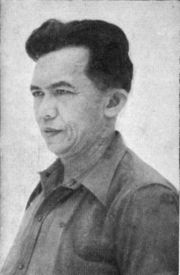
Ibrahim Simabua Datuak Sutan Malaka
Indonesian anti-colonial revolutionary thinker, teacher, and political organizer
of 100 · stable trend · Strong moral/spiritual alignment
Standing
86/100
Raw Score
75/85
Confidence
68%
Evidence
Strong with contested interpretation
About
Tan Malaka paired anti-colonial politics with worker education, school-building, and unusual personal sacrifice across exile, prison, and underground struggle.
The observable record is strongly positive on courage, public-facing care for workers and students, and endurance under repression, but more mixed on integrity because parts of the 1946 power struggle and later revolutionary factionalism remain contested.
Five Pillars
Pillar scores (0–100%)
Very strong on belief, worship baseline, sacrifice, and resilience; clearly positive on social care through worker and student uplift; materially more mixed on integrity because revolutionary coalition politics and 1946 accusations remain contested.
Goodness over time
Starts at 100 at birth, natural decay after accountability age, timeline events adjust the trajectory.
17 Criteria Scores
Individual item scores (0–5) with evidence notes
Core Worldview
Publicly identifiable as Muslim and explicitly framed anti-colonial politics in Islamic as well as Marxist terms.
Muslim assumption-of-best applies; no meaningful contrary evidence found.
Muslim assumption-of-best applies; no meaningful contrary evidence found.
His Pan-Islamism speech and alliance arguments treated Islam as morally and politically serious guidance.
Muslim assumption-of-best applies; no contrary public evidence found.
Contribution to Others
The accessible record is more public-political than family-centered, so this stays moderate rather than high.
His school-building work clearly benefited young people outside colonial education channels.
Worker-focused teaching and writing against coolie exploitation are among the clearest positive proofs in the record.
Only limited direct public evidence was found on this specific dimension.
He repeatedly responded to movement needs and requests for political help, but evidence is indirect.
Anti-colonial struggle was the central through-line of his public life.
Personal Discipline
Muslim assumption-of-best applies; accessible sources do not provide contrary evidence.
Muslim assumption-of-best applies; accessible sources do not provide contrary evidence.
Reliability
He showed real strategic conviction, but the 1946 coalition episode and coup-related allegations keep this only moderate.
Stability Under Pressure
Long exile, underground life, and repeated insecurity did not end his public commitments.
He endured illness, imprisonment, and arrest without obvious retreat from his core cause.
He remained active through the violent closing phase of the revolution and died after capture.
Timeline
Key events and documented turning points
Taught plantation laborers' children and wrote about coolie suffering
After returning from the Netherlands, Tan Malaka taught children of plantation laborers in East Sumatra and published journalism describing the suffering and inequality surrounding the coolie system.
→ Built an early public record of siding with exploited workers and using education plus writing as instruments of social concern.
highBuilt Sarekat Islam schools as an alternative to colonial education
In Semarang he helped create the Sarekat Islam School network, which spread beyond the city and became a major source of his prestige among workers and activists.
→ Expanded educational access and political formation for young people outside government schools.
highArrest, exile, and election campaign against Dutch colonial rule
Dutch authorities arrested and exiled him in 1922. In the Netherlands he ran on the Communist Party ticket not because he expected office, but to publicize Dutch conduct in Indonesia and press support for Indonesian independence.
→ Turned repression into a wider political platform instead of retreating from public struggle.
highArgued that Islam and anti-colonial class struggle could cooperate
At the Fourth Comintern Congress he argued that Muslim anti-colonial movements should not be treated as enemies of liberation politics, presenting Pan-Islamism as a real force among oppressed peoples.
→ Left a lasting record of trying to reconcile Islamic identity with revolutionary anti-imperial politics.
mediumOpposed a premature PKI revolt and argued the movement was unready
When PKI leaders pushed toward revolt, Tan Malaka rejected the plan as strategically unsound and tried to stop it, arguing the organization was too weak for success.
→ Showed willingness to oppose his own side when he believed the movement was not ready, though the revolt went ahead without him.
mediumLed Persatuan Perjuangan against negotiated settlement with the Dutch
After independence, he organized the Persatuan Perjuangan coalition around a minimum program demanding full independence and rejecting compromise with the Dutch. The coalition drew broad support but he could not convert it into stable governing control and was soon arrested.
→ Displayed strong commitment and mobilizing ability, but the episode remains mixed because the coalition deepened political rupture and his exact role in later coup-related accusations remains disputed.
highCaptured and executed after trying to continue armed resistance
During the Indonesian revolution's violent closing phase, Tan Malaka was captured in East Java and executed after arrest by forces aligned with the republican army while still trying to sustain resistance to Dutch military pressure.
→ His death fixed him in Indonesian history as a sacrificial but deeply contested anti-colonial figure.
highPressure Tests
Behavior under crisis or scrutiny
Dutch exile after school-based organizing
1922Colonial authorities arrested and exiled him after concluding his organizing and schools were threatening.
Response: He widened the fight by campaigning in the Netherlands and continuing international anti-colonial work.
positivePressure to back the 1926 PKI revolt
1926Allies pushed toward an uprising he judged premature.
Response: He opposed the revolt and tried to stop it despite movement pressure.
positiveLate-revolution fragmentation and military danger
1949He operated in a chaotic battlefield environment where Dutch offensives, republican factionalism, and local command conflict converged.
Response: He kept moving with armed resistance networks and died after capture and execution.
mixed_positiveProgression
crisis years
Factional politics, arrest without trial, and revolutionary fragmentation made the record more mixed on integrity even while resilience remained high.
mixedcurrent stage
His legacy is posthumous: officially honored, academically revived, and still debated because the record blends sacrifice with hard-edged revolutionary politics.
stableearly years
Village religious formation, teacher training, and early sensitivity to inequality prepared him for a public life centered on instruction and dissent.
upwardgrowth years
His strongest constructive phase combined schools, worker advocacy, journalism, and international anti-colonial networking.
upwardBehavioral Patterns
Positive
- • Repeatedly turned education into a political and social-care instrument for workers and youth.
- • Maintained anti-colonial commitment through exile, prison, and clandestine organizing.
- • Tried to bridge Islam and anti-imperial politics instead of treating faith as disposable.
Concerns
- • Revolutionary coalition politics repeatedly put him near factional rupture and accusations of extra-constitutional power seeking.
- • Historical evidence is broad but not equally sharp on every episode, especially the 1946 struggle and some final-year details.
Evidence Quality
5
Strong
3
Medium
1
Weak
Overall: strong_with_contested_interpretation
This profile measures observable public behavior and evidence patterns, not hidden intention, private sincerity, or final spiritual standing.