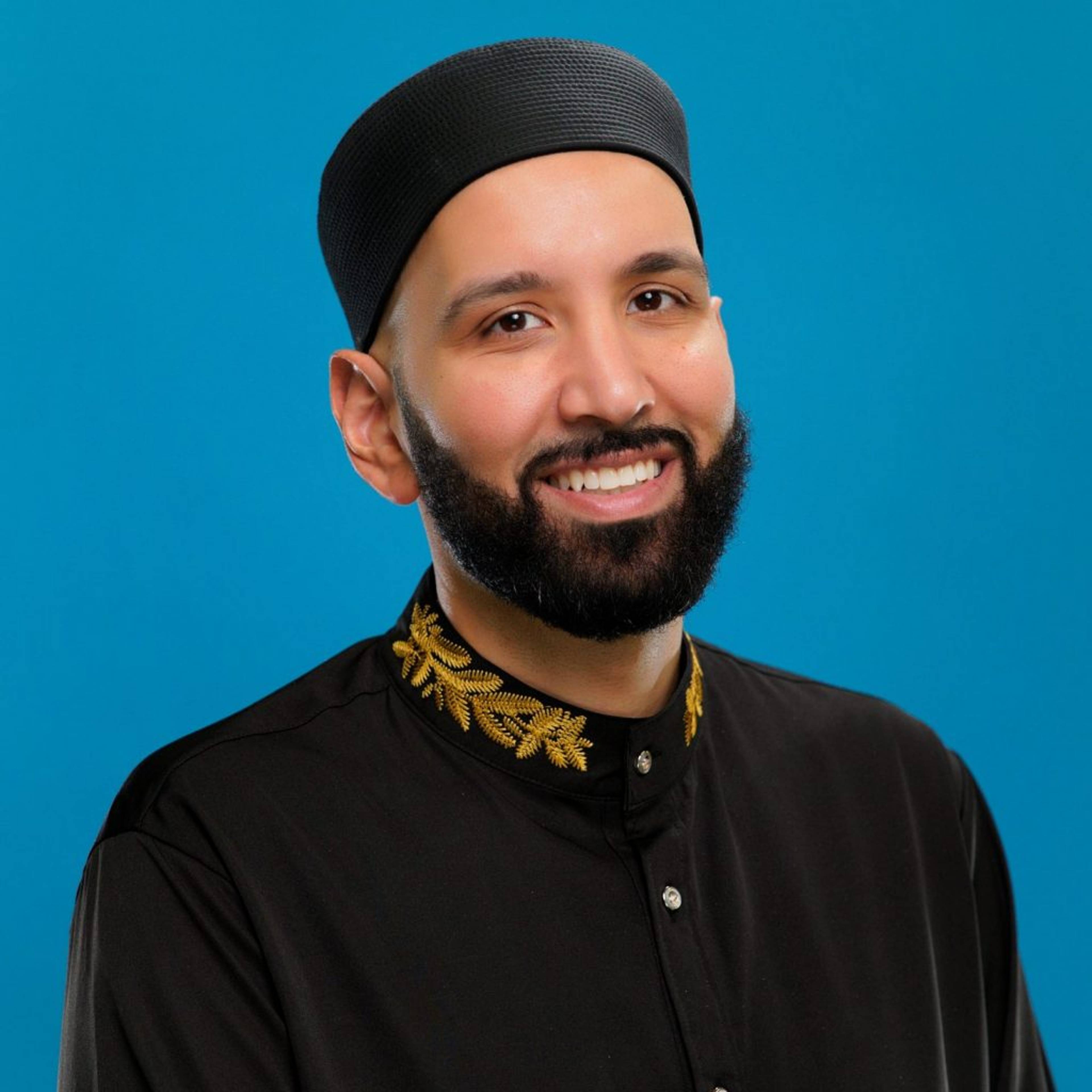
Omar Suleiman
American Muslim imam, scholar, author, and civil-rights activist; founder and president of the Yaqeen Institute, founding director of MUHSEN, resident scholar at Valley Ranch Islamic Center, and adjunct professor of Islamic Studies at Southern Methodist University.
of 100 · stable trend · Strong moral/spiritual alignment
Standing
87/100
Raw Score
74/85
Confidence
78%
Evidence
Strong with contested public reputation
About
American Muslim imam and activist whose public record is strongest on institution-building, vulnerable-community advocacy, and bridge-building under pressure.
The strongest evidence supports a high-belief, high-worship, and strong social-care profile grounded in sustained public service and repeated advocacy for marginalized people. The main cautions are that some criticism centers on polarizing rhetoric, coalition choices, and incomplete observability of private-family and financial-life conduct rather than on proven exploitation or corruption.
Five Pillars
Pillar scores (0–100%)
Raw score 74 out of 85 and weighted score 87.0 out of 100. Omar Suleiman's record is strongest on Muslim belief and worship observability by explicit identity plus sustained public-facing social care through refugees, migrants, disability inclusion, anti-racism, and interfaith solidarity. The score is held below the very top tier by thinner visibility into private-family and financial hardship conduct, and by recurring public controversy around rhetoric, political associations, and coalition choices.
Goodness over time
Starts at 100 at birth, natural decay after accountability age, timeline events adjust the trajectory.
17 Criteria Scores
Individual item scores (0–5) with evidence notes
Core Worldview
Explicit public Muslim identity, scholarship, and preaching.
His teaching and writing repeatedly frame life through accountability before God.
Core Islamic metaphysics and afterlife themes are central in his public ministry.
He explicitly grounds activism and ethics in Qur'an and Sunnah.
His public framework repeatedly presents the Prophet as the model for justice and mercy.
Contribution to Others
Public record is thin on family-directed support beyond ordinary references to parents and heritage.
Youth-oriented education and community work are visible, but direct orphan-focused evidence is limited.
Refugee aid, anti-poverty framing, and repeated defense of targeted communities are strong and sustained.
His refugee and migrant advocacy directly centers displaced and cut-off people.
He publicly responds to communities asking for advocacy, clarification, and pastoral support.
DACA, policing, Islamophobia, and family-separation activism show a repeated concern with coercive systems.
Personal Discipline
As a clearly identified Muslim imam, he receives the assumption-of-best absent contrary evidence.
As a clearly identified Muslim imam, he receives the assumption-of-best absent contrary evidence.
Reliability
The record shows durable institutional commitments and some explicit self-correction, with caution for occasional ambiguity around associations and public messaging.
Stability Under Pressure
Not enough direct hardship evidence for a stronger score, but no contrary record is visible.
Sustained public ministry through hostility, scrutiny, and emotionally heavy advocacy suggests strong personal steadiness.
He has repeatedly stayed publicly engaged during arrests, backlash, and acute interfaith crisis moments.
Timeline
Key events and documented turning points
Co-founded MUHSEN to build disability inclusion in Muslim communities
MUHSEN was established to address the absence of support and accessibility for Muslims with disabilities and their families, making disability inclusion a sustained part of Suleiman's public ministry.
→ Created a durable nonprofit channel for accommodation, advocacy, and community inclusion.
highFounded the Yaqeen Institute for Islamic Research
Suleiman launched Yaqeen as an institution aimed at preserving Islamic conviction, answering doubt, and framing public ethics through Islamic sources.
→ Built one of the most visible American Muslim research and education institutions.
highVisited Syrian refugee camps and publicly framed support as a moral obligation
PBS documented Suleiman's visits to the Jordan-Syria border, where he helped deliver aid, took American youth to witness conditions, and argued that refugees should be treated as human beings with a right to peace and security.
→ Turned religious teaching into direct humanitarian presence and advocacy.
highPresented and co-authored a paper rejecting domestic violence and honor killings
Through Yaqeen, Suleiman helped present a critical Islamic argument against domestic violence and honor killings at a crimes-against-women forum.
→ Strengthened a public record of using scholarship against violence and misogynistic abuse.
mediumAccepted arrest during a Capitol Hill protest for Dreamers
He joined Muslim and Jewish activists in civil disobedience outside House Speaker Paul Ryan's office to demand protection for undocumented immigrants brought to the United States as children.
→ Showed willingness to absorb personal cost for a public commitment.
mediumProtested child-family separation and dehumanizing border policy
After visits to the border and demonstrations in McAllen and Tijuana, Suleiman wrote and spoke publicly against family separation, tear gas, and the moral numbness surrounding migrant suffering.
→ Deepened a repeated pattern of siding with displaced and politically vulnerable people.
highHouse prayer invitation triggered a high-profile smear cycle and forced public clarification
After giving the opening prayer in the U.S. House, Suleiman faced accusations of extremism and anti-Semitism based largely on old posts and polemical framing. He answered with a detailed statement rejecting anti-Semitism while acknowledging that he had said regrettable things in the past.
→ The episode raised real reputational questions but also produced a transparent correction-and-clarification record.
mediumJoined interfaith response during the Colleyville synagogue hostage crisis
During the Colleyville synagogue hostage crisis, Suleiman joined other faith leaders in supporting the rabbi's family and offering assistance; Dallas County and Texas officials later honored his role.
→ Strengthened an observable pattern of interfaith solidarity under fear and uncertainty.
highClosed a decade-long SMU chapter while keeping public work centered on teaching and moral advocacy
In his October 2, 2025 note, Suleiman described the end of his three-year ethics-board term and reflected on a decade of teaching, advising, and guest lecturing at SMU.
→ Shows continuity and institutional durability rather than abrupt retreat from public-facing educational work.
mediumPressure Tests
Behavior under crisis or scrutiny
DACA civil-disobedience arrest
2018He joined a Capitol Hill protest for Dreamers and was arrested with Muslim and Jewish activists.
Response: He publicly treated the arrest as part of keeping pressure on lawmakers rather than as a reason to retreat from the issue.
positiveBacklash after House invocation
2019After delivering the opening prayer in the U.S. House, he was accused online of extremism and anti-Semitism.
Response: He responded with a detailed public defense, rejected anti-Semitism, acknowledged past regrets, and framed the episode as an effort to preserve Muslim-Jewish solidarity.
mixedColleyville synagogue hostage crisis
2022During the synagogue hostage crisis in Colleyville, he joined other faith leaders to support the rabbi's family and offered assistance.
Response: The response strengthened a pattern of interfaith solidarity under acute pressure and was publicly honored by Dallas County and Texas officials.
positiveProgression
crisis years
Arrests, border protests, congressional backlash, and public criticism tested whether activism would become reactive or remain principled.
mixedcurrent stage
The current pattern is stable: high-output teaching and advocacy, broad influence, and ongoing contestation rather than decline.
stableearly years
Traditional study and early teaching grew into a ministry shaped by worship, scholarship, and civic conscience.
upgrowth years
From MUHSEN through Yaqeen, he shifted from local leadership to national institution-building with a consistent justice vocabulary.
upBehavioral Patterns
Positive
- • Turns belief claims into organized public obligations through nonprofits, teaching, and direct advocacy.
- • Uses interfaith and civic settings to humanize Muslims while also defending other targeted communities.
- • Keeps returning to people under pressure: refugees, migrants, disabled Muslims, and communities hit by hate.
Concerns
- • Can leave unresolved ambiguity when he chooses coalition breadth and bridge-building over sharper public distancing from controversial people or spaces.
- • Public reputation is vulnerable to recurring cycles of backlash because old rhetoric and activism are easily recirculated outside fuller context.
- • Family-centered and private-life goodness indicators remain less observable than institutional and activist indicators.
Evidence Quality
13
Strong
5
Medium
1
Weak
Overall: strong_with_contested_public_reputation
This profile evaluates observable conduct and public evidence, not the unseen state of a person's soul.