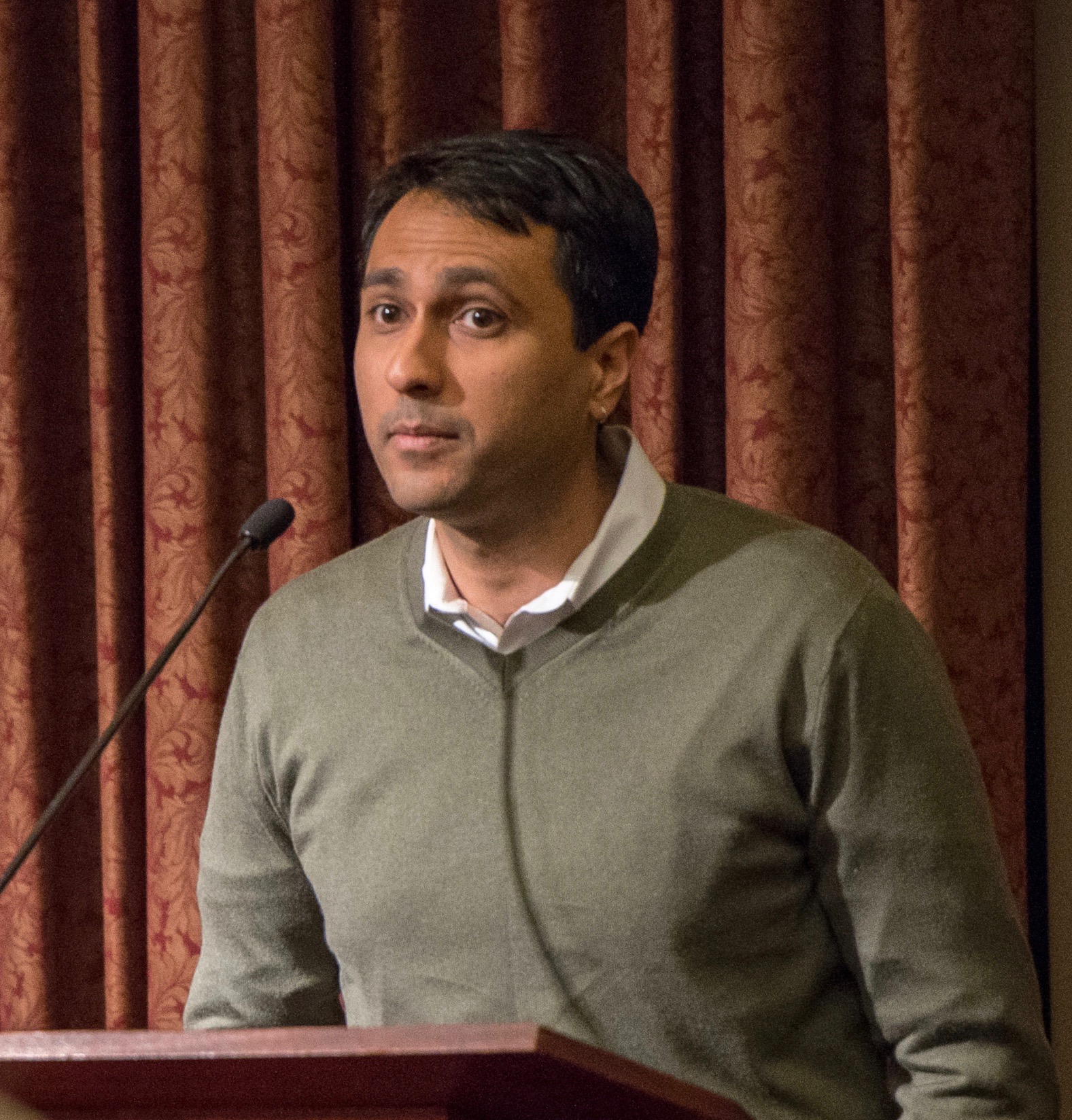
Ebrahim "Eboo" Patel
Founder and president of Interfaith America, author, speaker, and civic pluralism advocate
of 100 · improving trend · Strong moral/spiritual alignment
Standing
85/100
Raw Score
72/85
Confidence
82%
Evidence
Strong
About
Patel has spent more than two decades building interfaith cooperation into campuses and civic institutions, translating religious diversity into service, bridge-building, and public leadership.
The public record shows unusually consistent institution-building, explicit Muslim moral framing, and broad service-oriented impact. The main caution is that his bridge-building style is sometimes criticized as too reluctant to engage sharper power conflicts directly.
Five Pillars
Pillar scores (0–100%)
Patel scores highest on belief, worship, and long-term social institution-building. The score is held below exemplary range by limited public visibility into private-life care obligations and by substantive criticism that his pluralism model can become too conciliatory or insufficiently structural in moments of conflict.
Goodness over time
Starts at 100 at birth, natural decay after accountability age, timeline events adjust the trajectory.
17 Criteria Scores
Individual item scores (0–5) with evidence notes
Core Worldview
Publicly self-identifies as a Muslim and frames pluralism through Quranic teaching.
Muslim assumption-of-best applies; no public evidence contradicts accountability-oriented belief.
Public religious language consistently treats divine order and meaning as real.
He cites the Quran directly as guidance for public cooperation.
Muslim assumption-of-best applies with no contrary evidence.
Contribution to Others
Family ethic appears in his public storytelling, but direct public evidence of ongoing family care is limited.
Youth-focused institution-building and earlier work with high-school dropouts show repeated support for young people.
IFYC and related service work repeatedly targeted homelessness, hunger, refugees, and campus-community needs.
His work explicitly seeks to welcome religious minorities, immigrants, and communities targeted by suspicion.
Campus and civic consulting work shows responsiveness, though not usually in direct one-to-one relief settings.
Pluralism work aims to reduce prejudice, exclusion, and identity-based constraint in public institutions.
Personal Discipline
Muslim assumption-of-best applies; public record does not suggest nonobservance.
Muslim assumption-of-best applies and his public ethic consistently affirms service and giving.
Reliability
He has pursued the same stated mission for decades and built durable partnerships, though critics question some strategic evasiveness.
Stability Under Pressure
He stayed with the project after repeated early funding rejection and improved the organization instead of quitting.
There is some evidence of personal strain and persistence, but the public record is thinner here than in professional hardship.
He kept public Muslim bridge-building work visible through Islamophobic and polarized periods without abandoning the field.
Timeline
Key events and documented turning points
Worked with high-school dropouts and built an activist co-op in Chicago
After finishing college early, Patel taught in an alternative education program for high-school dropouts and founded a cooperative living community for activists and artists in Uptown Chicago, turning inherited religious ethics into direct community work.
→ Grounded his later public work in service, youth development, and community-building rather than abstract dialogue alone.
mediumFounded Interfaith Youth Core
Patel formally launched Interfaith Youth Core with a Ford Foundation grant after developing interfaith youth projects across several countries during his Oxford years.
→ Created the main institution through which his interfaith service model spread nationally.
highNational profile highlighted interfaith service model on campuses
PBS profiled Patel as a Muslim interfaith leader active on roughly 50 campuses, showing students serving refugees and learning one another's traditions through shared work.
→ Publicly documented that his model was moving beyond speeches into recurring service and campus formation.
highJoined President Obama's inaugural Faith Council
Patel was appointed to President Obama's inaugural Advisory Council on Faith-Based and Neighborhood Partnerships, bringing his interreligious cooperation model into federal advisory work.
→ Expanded his influence from nonprofit leadership into national policy advising.
highHelped shape the President's Interfaith and Community Service Campus Challenge
White House and Education Department materials credited Patel as a pivotal architect of the Campus Challenge, which scaled interfaith service as a higher-education priority nationwide.
→ His ideas became embedded in a nationally visible civic program with hundreds of participating institutions.
very_highPluralism framework drew criticism after Boston bombing commentary
A Religion Dispatches critique argued that Patel's framing of the Boston bombings as partly a failure of interfaith cooperation risked flattening structural causes such as race, surveillance, inequality, and power.
→ Marked a durable criticism of Patel's approach: that bridge-building language can become too binary or insufficiently structural.
mediumAdvanced a public pluralism narrative in Out of Many Faiths
In interviews around Out of Many Faiths, Patel argued for a "Potluck Nation" narrative and defended religious diversity as central to democratic life while noting anti-Muslim backlash around projects like Cordoba House.
→ Strengthened his role as a public intellectual shaping how interfaith work is explained beyond campuses.
highReflected on two decades of institution-building and early rejection
Patel publicly described learning from early funding rejections, resisting grievance-driven explanations, and keeping Interfaith America focused on building durable civic institutions rather than taking constant sides in public controversies.
→ Adds evidence of self-correction and steadiness under professional disappointment, while also clarifying why some critics view him as too nonpartisan.
mediumReceived major 2026 civic recognition for pluralism leadership
Interfaith America announced that Patel would receive the 2026 Bush Institute Citation, and the organization later noted his election to the American Academy of Arts and Sciences, signaling unusually broad civic recognition for his bridge-building work.
→ Recent trajectory points upward in institutional influence and public credibility.
highPressure Tests
Behavior under crisis or scrutiny
Early foundation rejections while launching IFYC
2000Major funders declined early pitches, leaving Patel frustrated and tempted to explain failure mainly through bias.
Response: He accepted mentor advice to improve track record, evaluation, and follow-through, then kept building.
positivePost-9/11 and anti-Muslim climate
2001Patel built public Muslim interfaith leadership in a period of elevated Islamophobia and religious suspicion.
Response: He doubled down on a Quran-grounded public message that difference should lead to knowing one another and serving together.
positiveCritique after Boston bombing commentary
2013Scholars challenged his tendency to explain violence through failures of interfaith cooperation.
Response: He did not abandon the project; instead he kept refining a public case for pluralism while accepting that critics saw blind spots in the frame.
mixedProgression
crisis years
Public tension centered less on scandal than on whether his pluralism frame is too conciliatory for harder conflicts.
testedcurrent stage
Continues scaling pluralism through media, civic partnerships, and institutional recognition, with growing national stature.
strengtheningearly years
Youth service, teaching, and family-shaped moral imagination laid the foundation for later public work.
forminggrowth years
Built Interfaith Youth Core into a national youth and campus platform with government and nonprofit reach.
expandingBehavioral Patterns
Positive
- • Sustained institution-building around youth service and religious cooperation
- • Open Muslim moral language paired with practical cooperation across difference
- • Keeps returning to campuses and civic institutions rather than one-off media moments
Concerns
- • Pluralism framework is criticized for sometimes flattening power, race, and state-violence dynamics
- • Reluctance to take sides on divisive issues can look evasive to critics seeking stronger moral confrontation
Evidence Quality
9
Strong
4
Medium
1
Weak
Overall: strong
This profile evaluates publicly observable behavior, commitments, and patterns. It does not judge hidden intentions, private faith beyond available evidence, or ultimate spiritual standing.