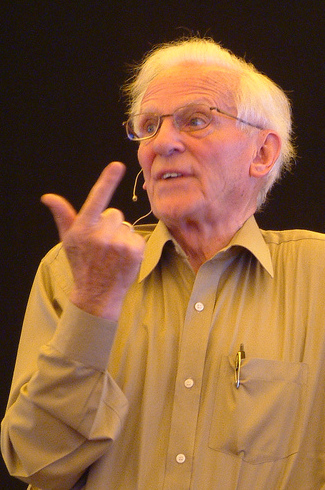
Andrew "Anne" van der Bijl
Dutch Christian missionary, author, and founder of Open Doors
of 100 · stable trend · Strong moral/spiritual alignment
Standing
83/100
Raw Score
70/85
Confidence
68%
Evidence
Moderately strong but mission-skewed
About
Brother Andrew built Open Doors after encountering isolated churches behind the Iron Curtain, then spent decades moving Bibles, relief, training, and advocacy toward persecuted Christians. The strongest caution is that some of his signature tactics were illegal and were criticized by other Christian groups and some Chinese church voices as risky for local believers.
The observable pattern is strongly positive. He repeatedly accepted personal risk, kept his mission focused on people who were cut off or pressured, and remained publicly committed to prayer, service, and dialogue even in hostile settings. The profile stops short of an unqualified judgment because the smuggling model was openly contested and some of its downstream effects were harmful to local Christians under surveillance.
Five Pillars
Pillar scores (0–100%)
Brother Andrew scores highest where the evidence is clearest: explicit faith, repeated service to isolated believers, and courage under pressure. The main deductions come from the contested ethics and consequences of illegal smuggling tactics, plus thinner public evidence on family-specific care and private material giving.
Goodness over time
Starts at 100 at birth, natural decay after accountability age, timeline events adjust the trajectory.
17 Criteria Scores
Individual item scores (0–5) with evidence notes
Core Worldview
His public life is explicitly theistic and scripture-driven.
He consistently framed sacrifice and mission in eternal-accountability terms.
His ministry language repeatedly appealed to providence, prayer, and divine intervention.
He built his mission around biblical texts and obedience to scripture.
His public model emphasized imitation of Jesus and biblical exemplars.
Contribution to Others
Public evidence centers on mission work rather than family-specific care.
Some support reached young believers, but this is not a dominant public pattern.
He repeatedly directed practical support toward persecuted and materially pressured believers.
This is one of the clearest patterns: he sought out isolated communities others avoided.
He described the mission as answering requests from local pastors and churches.
Bible access, training, advocacy, and small-loan support aimed to reduce coercion and isolation.
Personal Discipline
Prayer is explicit and recurrent across his public testimony and ministry language.
His record shows long-run disciplined giving of time, risk, and institutional resources to others.
Reliability
His mission stayed remarkably consistent, but illegal smuggling tactics and downstream risks keep the score below perfect.
Stability Under Pressure
The record shows endurance and sacrifice, though direct public evidence about personal financial hardship is limited.
He kept serving across decades of danger, travel strain, and public hostility.
He repeatedly chose risky border crossings and hostile dialogue rather than safer distance.
Timeline
Key events and documented turning points
Poland trip turns private faith into a mission for isolated churches
At a communist youth congress in Poland, van der Bijl encountered Christians who felt abandoned and short of Bibles, support, and prayer. He treated that visit as the start of a life mission to strengthen persecuted believers.
→ This trip became the founding impulse for the work later known as Open Doors.
highRepeated Bible runs behind the Iron Curtain grow into Open Doors
He returned behind communist borders again and again, carrying Bibles and Christian literature and building a network that became Open Doors. He described the work as service to churches that asked for help, not fame or profit.
→ Open Doors grew from a one-man effort into a durable international support network.
highProject Pearl delivers one million Bibles to China in one night
Open Doors coordinated the clandestine delivery of one million Bibles onto a Chinese beach, responding to hunger for scripture among believers who had very limited access during and after the Cultural Revolution.
→ Many Chinese believers later described the shipment as catalytic for church growth and Bible access.
highBible-smuggling tactics draw criticism and expose local believers to pressure
Other Christian organizations argued that Bible smuggling was dangerous and sometimes ineffective, while Chinese Christians connected to Project Pearl later described investigations, detention, and harassment after the delivery.
→ The controversy does not erase the help delivered, but it is a real integrity and consequence check on the method.
mediumThe mission expands from smuggling to training, small loans, and hard dialogue in the Middle East
By the late 1990s, Brother Andrew described Open Doors as training pastors, supporting business start-ups for discriminated Christians, and keeping contact with actors from Hamas, Islamic Jihad, and Hezbollah in order to serve threatened churches.
→ His work broadened from literature delivery to long-term material and spiritual support, while also creating controversy around who he was willing to meet.
highAfter 9/11 he publicly rejects vengeance language and urges prayer even for enemies
In the post-9/11 climate and during the war on terror, Brother Andrew criticized Christian reliance on military solutions and said believers should pray even for figures such as Osama bin Laden because people are not the final enemy.
→ This stance strengthened the profile on witness under pressure, though many listeners viewed it as provocative or naive.
mediumHe dies after Open Doors grows into a global ministry serving persecuted Christians
At his death in 2022, the organization he founded was operating in more than 60 countries and was still distributing Bibles, training materials, relief, and advocacy support to persecuted Christians.
→ The late-life record confirms that the core commitment lasted for decades rather than fading after the Cold War.
highPressure Tests
Behavior under crisis or scrutiny
Cold War border crossings
1957He repeatedly crossed into communist countries carrying prohibited Christian literature.
Response: He continued the work with prayer and a stated refusal to lie or profit from it.
Strong courage and commitment, but mixed integrity optics because the method was illegal and risky for others.Project Pearl backlash
1981The huge Bible delivery to China helped many believers but also brought investigations and detention for some locals.
Response: He and Open Doors stood by the operation as a response to desperate need.
High sacrificial intent with a real consequence cost that must stay visible.Post-9/11 climate
2001In a fear-heavy public moment, he urged Christians to pray for enemies and warned against trusting military power.
Response: He held to witness and dialogue instead of mirroring vengeance rhetoric.
Strong evidence of composure and principle under ideological pressure.Progression
current stage
Late-life respect remains high, but public assessment has to include criticism of tactics and consequences.
stableearly years
A single exposure to isolated believers becomes a binding long-term obligation.
toward servicegrowth years
Risky one-man deliveries mature into an international ministry with broader support services.
broadening impactBehavioral Patterns
Positive
- • He consistently prioritized hard-to-reach believers over prestige-friendly ministry settings.
- • He answered concrete requests from local churches rather than presenting the work as unilateral rescue.
- • He kept prayer and direct witness central even while the organization professionalized.
Concerns
- • Some admired courage was inseparable from tactics that could expose local believers to retaliation.
- • His public focus was narrow: strong care for persecuted Christians, thinner proof of broader or family-centered obligations.
Evidence Quality
5
Strong
2
Medium
0
Weak
Overall: moderately strong but mission-skewed
This profile evaluates observable public behavior and evidence, not the state of a person's soul.