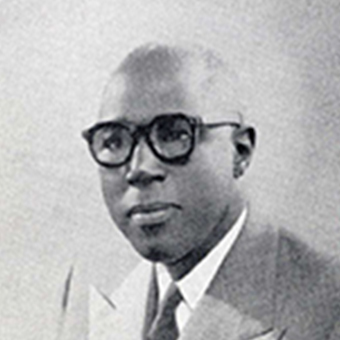
Amadou Lamine-Guèye
Senegalese lawyer, socialist politician, longtime mayor of Dakar, and first president of the National Assembly of Senegal
of 100 · stable trend · Visibly decent and improving
Standing
76/100
Raw Score
65/85
Confidence
68%
Evidence
Strong
About
Lamine Guèye helped push French citizenship and voting rights outward to colonized subjects and spent decades in top municipal and parliamentary office. The main caution is that his politics stayed tied to elite assimilationist currents and he was part of the institutional front that isolated Mamadou Dia during Senegal's 1962 crisis.
The observable record is materially positive on public responsibility because Guèye repeatedly used law and office to widen civic status for excluded people, including through the 1946 law that bears his name. The score stays below exemplary because the evidence is much thinner on direct personal charity than on institutional reform, and because his role in the 1962 showdown and his narrow urban political base complicate trust and breadth-of-care judgments.
Five Pillars
Pillar scores (0–100%)
Guèye scores strongest where the public evidence is hardest to dispute: he used office and law to widen civic status for excluded colonial subjects and then stayed in durable public service. The profile remains mixed rather than exemplary because his record is much more institutional than intimate, and because the 1962 crisis keeps a real integrity cloud over his legacy.
Goodness over time
Starts at 100 at birth, natural decay after accountability age, timeline events adjust the trajectory.
17 Criteria Scores
Individual item scores (0–5) with evidence notes
Core Worldview
Public record identifies him as Muslim; no contrary evidence located.
Muslim assumption-of-best applied; no public contradiction located.
Muslim assumption-of-best applied; no public contradiction located.
Muslim assumption-of-best applied; no public contradiction located.
Muslim assumption-of-best applied; no public contradiction located.
Contribution to Others
Public evidence on family-specific care is limited.
Little direct evidence of focused support for orphans or unsupported youth.
Citizenship and voting-rights work materially helped excluded colonial subjects.
His rights advocacy reached people structurally cut off from equal civic status.
Repeated parliamentary advocacy suggests responsiveness to public political demands.
The 1946 law is strong evidence of helping free people from formal legal constraint.
Personal Discipline
Muslim assumption-of-best applied; no contrary evidence located.
Muslim assumption-of-best applied; no contrary evidence located.
Reliability
Long officeholding supports baseline reliability, but the 1962 crisis and narrow elite politics keep this mixed.
Stability Under Pressure
Public evidence here is thin rather than clearly negative.
Career persistence through setbacks supports a moderate score.
He remained active through intense political conflict and state transition.
Timeline
Key events and documented turning points
Became one of the first Black lawyers from French West Africa after studying in Paris
After teaching and military service, Guèye completed law studies in France and entered legal practice, giving him unusual leverage to challenge colonial inequality through institutions rather than only rhetoric.
→ Created the professional base for his later rights advocacy and public leadership.
mediumServed as mayor of Dakar for roughly sixteen years while also holding national and international office
Guèye was elected mayor of Dakar in 1945 and kept the post until 1961 while also serving as deputy, senator, and later a French representative to the United Nations.
→ Showed durability in office and an ability to keep public authority over a long span.
highDrove the law associated with his name that extended citizenship and voting rights across French overseas territories
As deputy for Senegal-Mauritania, Guèye pushed the 1946 law later known as the Loi Lamine Guèye, which the French National Assembly later described as extending the vote to all French overseas citizens and ending a major layer of colonial exclusion.
→ Became his clearest durable public contribution and a major reason he remains historically significant.
highLost political dominance after Senghor broke away and built a broader rural coalition
Britannica and French parliamentary biography both describe how Senghor left Guèye's socialist orbit, built a wider mass base, and reduced Guèye's appeal to a narrower urban bourgeois electorate.
→ Exposed the limits of Guèye's political reach and weakened his claim to represent the full social breadth of Senegal.
mediumBecame president of Senegal's legislative assembly and then its National Assembly
After Senegal became an autonomous republic and then independent, Guèye moved into the presidency of the legislative assembly and remained at the head of the National Assembly until his death in 1968.
→ Put him inside the core institutional architecture of the new state rather than outside it.
highHis home became the site where the anti-Dia motion of censure was completed during Senegal's 1962 crisis
During the power struggle between President Senghor and Prime Minister Mamadou Dia, the motion of censure against Dia's government was ultimately voted at Guèye's home after a clash over parliament's authority.
→ Left Guèye tied to one of the republic's defining early legitimacy disputes, even if supporters framed the move as defense of parliament.
highPressure Tests
Behavior under crisis or scrutiny
Break with Senghor and electoral defeat
1951Senghor broke from Guèye's orbit, built a wider coalition, and pushed Guèye out as the central national figure.
Response: Guèye remained in public life and later re-entered the ruling camp instead of disappearing from politics.
mixed1962 constitutional crisis
1962Parliament, the executive, and security forces collided over whether Mamadou Dia's government could block a motion of censure.
Response: Guèye stood with the parliamentary process that removed Dia, but the setting and consequences make the judgment morally contested.
mixed_negativeProgression
current stage
Shifted from insurgent rights advocate to institutional elder within Senghor-era state power.
mixed_legacyearly years
From teacher and soldier to lawyer and magistrate with unusual institutional fluency.
formationgrowth years
Turned legal skill into formal political advocacy for citizenship and voting rights.
expandingBehavioral Patterns
Positive
- • Repeatedly used formal institutions, not only protest language, to expand political rights.
- • Sustained public office over a long period across colonial and postcolonial transition.
Concerns
- • Movement strength depended heavily on educated urban elites rather than a broad cross-class coalition.
- • The 1962 crisis leaves a lasting question about whether he defended institutions neutrally or sided with the winning power bloc.
Evidence Quality
5
Strong
2
Medium
0
Weak
Overall: strong
This profile evaluates observable public behavior and evidence, not the state of a person's soul.