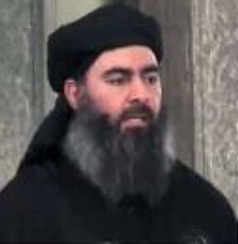
Ibrahim Awwad Ibrahim al-Badri
Islamic State leader
of 100 · declining trend · Goodness is mostly theoretical
Standing
3/100
Raw Score
2/85
Confidence
92%
Evidence
High
About
Baghdadi led a movement defined by terror, enslavement, sectarian killing, and coercive rule, making this one of the clearest harmful profiles in the database.
His public conduct directly contradicts the framework's care, integrity, and accountable-guidance dimensions.
Five Pillars
Pillar scores (0–100%)
His public conduct directly contradicts the framework's care, integrity, and accountable-guidance dimensions.
Goodness over time
Starts at 100 at birth, natural decay after accountability age, timeline events adjust the trajectory.
17 Criteria Scores
Individual item scores (0–5) with evidence notes
Core Worldview
See structured timeline and summary for public evidence.
See structured timeline and summary for public evidence.
See structured timeline and summary for public evidence.
See structured timeline and summary for public evidence.
See structured timeline and summary for public evidence.
Contribution to Others
See structured timeline and summary for public evidence.
See structured timeline and summary for public evidence.
See structured timeline and summary for public evidence.
See structured timeline and summary for public evidence.
See structured timeline and summary for public evidence.
See structured timeline and summary for public evidence.
Personal Discipline
See structured timeline and summary for public evidence.
See structured timeline and summary for public evidence.
Reliability
See structured timeline and summary for public evidence.
Stability Under Pressure
See structured timeline and summary for public evidence.
See structured timeline and summary for public evidence.
See structured timeline and summary for public evidence.
Timeline
Key events and documented turning points
Assumed leadership of the Islamic State of Iraq
After the deaths of earlier leaders, Baghdadi consolidated command of the insurgent organization that later became ISIS.
→ Set the stage for broader territorial conquest and mass abuse.
highDeclared a caliphate after ISIS captured large territory
Baghdadi used battlefield gains in Iraq and Syria to claim religious and political authority over Muslims worldwide.
→ Expanded the scale of coercion, displacement, and propaganda-based violence.
highUN investigators concluded ISIS was committing genocide against Yazidis
The UN described ISIS atrocities including killings, rape, and enslavement against Yazidis under the group's command structure.
→ Provided one of the clearest public records of the movement's radically anti-human conduct.
highDied during a U.S. raid after ISIS territorial collapse
Baghdadi died in northwestern Syria as the organization he led lost most of its territory and governing capacity.
→ Marked the end of his direct operational leadership but not the end of the harm he set in motion.
mediumPressure Tests
Behavior under crisis or scrutiny
Leadership after insurgent succession
2010He inherited a damaged militant network under intense pressure.
Response: He rebuilt it into a more brutal coercive movement.
negativeTerritorial collapse
2019ISIS lost most of its land and faced sustained military pressure.
Response: The record shows no moral restraint or repair as power collapsed.
negativeProgression
crisis years
Even under pressure, the organization's treatment of civilians remained atrocious.
downcurrent stage
Deceased; legacy remains overwhelmingly destructive.
downearly years
Radicalization moved into organized militant leadership.
downgrowth years
Power expansion translated into broader abuse, not broader care.
downBehavioral Patterns
Concerns
- • Mass violence and enslavement.
- • Coercive rule justified with distorted religious claims.
- • No credible evidence of repair or restitution.
Evidence Quality
5
Strong
1
Medium
0
Weak
Overall: high
This profile measures public behavior and evidence, not hidden intention or salvation.