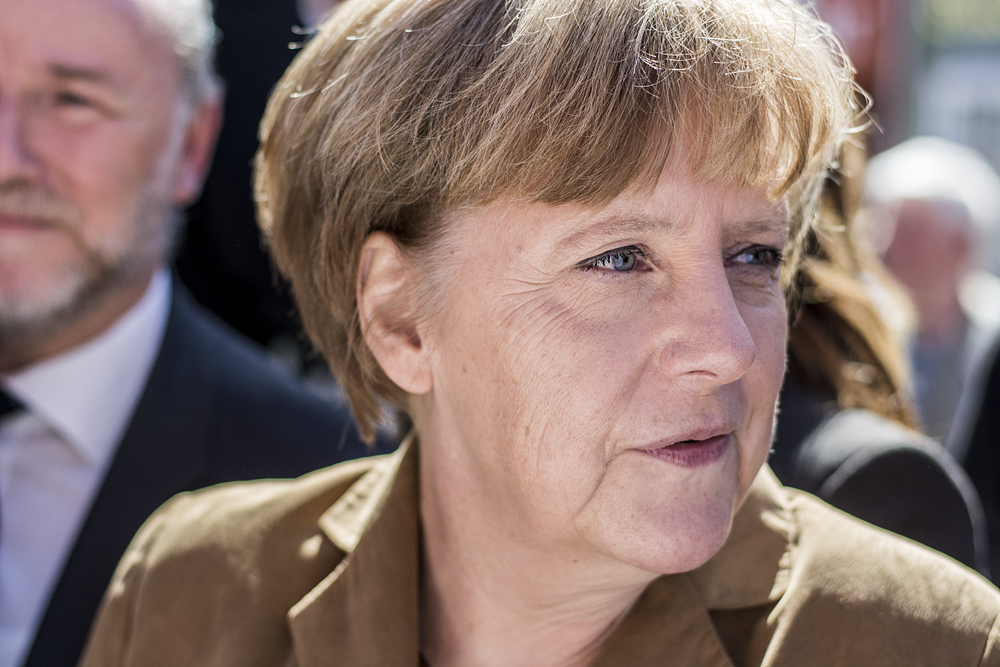
Angela Dorothea Merkel
Former Chancellor of Germany; physicist and Christian Democratic politician
of 100 · stable trend · Visibly decent and improving
Standing
58/100
Raw Score
50/85
Confidence
75%
Evidence
Strong with contested policy legacy
About
Former German chancellor whose public record shows durable service, unusual steadiness under pressure, and a major humanitarian commitment during the refugee crisis.
The strongest evidence supports resilience, disciplined public service, and a real willingness to protect displaced people. The main cautions are the harsh eurozone austerity legacy, underprepared refugee administration, and later criticism of her Russia-era strategic judgment.
Five Pillars
Pillar scores (0–100%)
Raw score 50 out of 85 and weighted score 57.5 out of 100. Merkel's strongest observable strengths are steadiness under pressure, institutional discipline, and a consequential willingness to protect refugees. The largest deductions come from lightly observable private worship, the human cost criticisms of eurozone austerity, and a strategic legacy on Russia and migration preparedness that remains contested.
Goodness over time
Starts at 100 at birth, natural decay after accountability age, timeline events adjust the trajectory.
17 Criteria Scores
Individual item scores (0–5) with evidence notes
Core Worldview
Publicly affirmed Christian faith and spoke of God, grace, and Christian roots, but the record is still lighter than her policy record.
Humility and moral accountability appear in her speeches, but explicit last-day language is sparse in the public record.
She publicly frames politics within a moral order larger than immediate expediency.
Her Reformation and Kirchentag remarks show positive orientation toward Christian revealed guidance.
Her public record draws more on Christian conscience and responsibility than on explicit prophetic emulation.
Contribution to Others
Little public evidence directly documents care centered on relatives as a recurring public pattern.
Refugee protection and integration efforts materially affected unsupported children and families, though not as a singular youth-focused mission.
Her migration and solidarity framing repeatedly addressed people trapped by war, instability, or crisis.
The clearest social-care signal is protection of refugees and asylum seekers arriving as strangers to Germany.
She responded to visible humanitarian need, though within state systems that also imposed limits and removals.
Her democratic-transition role, support for Ukraine's sovereignty, and procedural opening on marriage equality support a moderate score here.
Personal Discipline
Her faith is publicly acknowledged, but specific evidence of consistent private prayer is limited.
Public evidence of a regular, personal obligatory giving discipline is thin.
Reliability
She is known for careful, sober communication and long negotiation discipline, but some major policy legacies remain seriously disputed.
Stability Under Pressure
She remained steady through prolonged eurozone financial crisis negotiations.
Her long record from East German constraints to top office shows notable endurance and self-control.
Refugee backlash, Ukraine diplomacy, and the pandemic all show persistence under intense conflict pressure.
Timeline
Key events and documented turning points
Moved from scientific work into democratic transition politics in East Germany
Merkel joined the democratic movement at the end of 1989, became its press secretary, and after the first People's Parliament elections on March 18, 1990 was named acting government spokeswoman in the de Maiziere government.
→ Her political career began in a public setting defined by systemic upheaval rather than protected succession.
highElected Germany's first female chancellor
Merkel was elected chancellor on November 22, 2005, becoming the first woman and first East German to lead the federal government.
→ She gained authority over the main institutional platform through which her later crisis decisions would be judged.
highImposed a nuclear moratorium after Fukushima and accelerated the renewables turn
After the Fukushima disaster, Merkel's government suspended the recent extension of nuclear plant lifetimes, ordered a rigorous safety review, and accelerated the move toward renewables.
→ The decision showed willingness to prioritize public safety and revise course after a major external shock.
highBacked the Minsk package as part of a peaceful settlement effort for Ukraine
Merkel joined the February 12, 2015 declaration supporting the Minsk package, reaffirming Ukraine's sovereignty and the priority of an exclusively peaceful settlement.
→ The diplomacy did not end the conflict, but it showed sustained commitment to negotiation over military escalation.
highKept Germany open to large numbers of refugees during Europe's humanitarian emergency
When refugees headed for Europe in 2015, Merkel maintained that Germany would keep its borders open in the face of the humanitarian emergency; Germany ultimately welcomed more than 1.2 million refugees and asylum seekers in 2015 and 2016.
→ The decision spared many people forced return to war or instability, while also triggering major administrative and political strain.
highAbsorbed political backlash as migration pressures and anti-immigration sentiment intensified
More than one million migrants entered Germany in 2015, anti-immigration backlash grew, and the AfD made major gains in 2016 regional elections. Merkel later said the mistake had not been protection itself but failing to prepare conditions earlier so people could remain safely in their own regions.
→ She kept the protection principle, accepted political costs, and later acknowledged a real preparedness failure.
highCleared the way for a free vote that legalized same-sex marriage
Merkel allowed a free vote in the Bundestag on same-sex marriage; lawmakers approved the measure on June 30, 2017.
→ Although Merkel herself voted against the bill, she removed the procedural block that had kept the change from happening.
mediumAddressed the nation during the pandemic with an appeal to solidarity and disciplined restraint
In a national address, Merkel described COVID-19 as Germany's gravest challenge since World War II and argued that transparent democratic communication, disciplined behavior, and solidarity were needed to save lives.
→ Her public communication emphasized dignity, truthfulness, and shared responsibility during an emergency.
highReceived the UNHCR Nansen Refugee Award for refugee protection leadership
UNHCR awarded Merkel the 2022 Nansen Refugee Award, citing Germany's reception of more than 1.2 million refugees and asylum seekers in 2015 and 2016 under her leadership.
→ Later humanitarian recognition strengthened the positive reading of her most controversial care-centered decision.
mediumPressure Tests
Behavior under crisis or scrutiny
Eurozone debt crisis
2010Germany became the central political actor in repeated eurozone rescue negotiations amid pressure from creditors, debtor states, and domestic voters.
Response: Merkel stayed patient and procedurally steady, but her preferred austerity framework drew lasting criticism for social consequences.
mixedRefugee influx and backlash
2015Germany and Europe faced the largest refugee movement in decades, followed by logistical strain and major political backlash.
Response: Merkel kept the protection principle in place, thanked volunteers, later acknowledged underpreparedness, and accepted the political cost of the decision.
positiveCOVID-19 pandemic
2020Germany faced a once-in-a-century health emergency with severe social restrictions and public fear.
Response: She used transparent, sober public communication, stressed solidarity, and repeatedly explained the democratic basis for painful restrictions.
positiveProgression
crisis years
The refugee crisis, eurozone stress, Ukraine diplomacy, and pandemic tested whether caution could remain humane and effective under pressure.
mixedcurrent stage
Her legacy remains broadly positive on restraint and refugee protection, but more contested on austerity and Russia-era strategic assumptions.
stableearly years
A pastor's daughter raised in East Germany who moved from scientific work into democratic transition politics as the GDR collapsed.
upgrowth years
Her political rise turned technical discipline and coalition management into national leadership, culminating in the chancellorship.
upBehavioral Patterns
Positive
- • Repeatedly stayed composed in long, high-pressure negotiations and public crises.
- • Made one of Europe's most consequential refugee-protection decisions despite major political backlash.
- • Public speech often framed freedom, dignity, and responsibility as mutual obligations rather than slogans.
Concerns
- • Eurozone crisis management was criticized as too austerity-heavy and socially damaging, especially in Greece.
- • Merkel later admitted Europe had been underprepared for the 2015 refugee crisis even while defending protection itself.
- • Her Russia-era strategic legacy remains under critical re-evaluation after the later collapse of the European security order.
Evidence Quality
11
Strong
5
Medium
0
Weak
Overall: strong_with_contested_policy_legacy
This profile evaluates observable conduct and public evidence, not the unseen state of a person's soul.