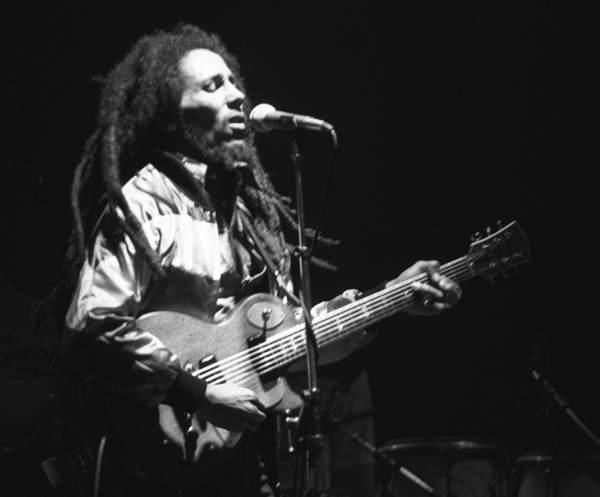
Robert Nesta Marley
Jamaican reggae singer-songwriter and public voice for peace, dignity, and anti-colonial liberation
of 100 · stable trend · Visibly decent and improving
Standing
65/100
Raw Score
56/85
Confidence
72%
Evidence
Strong with some contested interpretation
About
Bob Marley turned reggae into a global moral language for dignity, anti-oppression, and peace, and repeatedly accepted personal risk to carry that message in public.
The strongest public evidence supports resilience, liberation-centered social concern, and a sincere spiritual worldview. The main limits are thin direct evidence on private worship discipline, uneven evidence on concrete material aid, and a personal life that leaves some commitment questions unresolved.
Five Pillars
Pillar scores (0–100%)
Raw score 56 out of 85 and weighted score 64.5 out of 100. The strongest public signals are resilience under violence and illness, liberation-centered social concern, and a serious spiritual worldview. The main deductions come from limited evidence on structured charity and private worship, plus unresolved questions about steadiness in private commitments.
Goodness over time
Starts at 100 at birth, natural decay after accountability age, timeline events adjust the trajectory.
17 Criteria Scores
Individual item scores (0–5) with evidence notes
Core Worldview
Public faith language centered on Jah and scripture, but not in a clearly Islamic frame.
Redemption and judgment themes appear, but direct evidence is limited.
His public worldview was strongly spiritual and metaphysical.
He repeatedly treated scripture and revealed tradition as guiding authority.
Biblical-prophetic language was central, though the record is not equally specific on exemplar-following.
Contribution to Others
Large family ties are public, but the record is mixed and not especially well documented for this framework.
Not much direct public evidence beyond broad inspiration.
He consistently voiced the poor and wrote from their condition.
His peace and solidarity language reached alienated and cut-off communities across borders.
He returned for public peace efforts when called into dangerous civic moments.
Zimbabwe solidarity and anti-colonial witness are among his clearest public strengths.
Personal Discipline
Belief was public and serious, but direct observation of routine worship remains limited.
Some benefit and free performance evidence exists, but structured giving is lightly documented.
Reliability
He kept some major public commitments under pressure, though private commitment evidence is mixed.
Stability Under Pressure
Early poverty and long struggle are well documented.
He carried illness and danger without obvious collapse of public mission.
The 1976 shooting, One Love return, and Zimbabwe performance show unusual steadiness under conflict pressure.
Timeline
Key events and documented turning points
Broke through with songs written for Kingston's poor rather than for tourist tastes
With the Wailers' early hits such as 'Simmer Down,' Marley helped prove Jamaican popular music could speak directly for disenfranchised West Indians and not merely imitate overseas pop styles.
→ His music became a vehicle for dignity, protest, and self-recognition among marginalized listeners.
highReoriented his life and music around Rastafari belief and a liberation message
By the late 1960s Marley openly described Rastafari as central to his life and treated music as a mission to spread Jah-centered spiritual and historical consciousness.
→ Belief and art became tightly joined in his public identity, increasing both his influence and the seriousness of his message.
highPerformed at Smile Jamaica two days after surviving a politically charged shooting
After gunmen attacked his home on December 3, 1976, wounding Marley, Rita Marley, and others, he still took the stage at Smile Jamaica before a huge crowd and then left Jamaica for exile in London.
→ The performance became a durable symbol of personal courage, though the surrounding event also intensified debate about political alignment and risk.
highReceived the United Nations Medal of Peace after his public peace intervention
The United Nations recognized Marley's attempt to bridge Jamaica's political divide after the One Love Peace Concert.
→ The award reinforced the public reading of Marley as a peace figure, not only a music star.
mediumUsed the One Love Peace Concert to visibly press rival Jamaican leaders toward peace
Returning from exile, Marley headlined the One Love Peace Concert, brought Michael Manley and Edward Seaga onstage, and raised their hands together in one of Jamaica's best-known public peace gestures.
→ He created a powerful symbolic act of reconciliation, even though the concert did not end political killings.
highSought formal Christian baptism during terminal illness
While seriously ill, Marley was baptized by Abuna Yesehaq into the Ethiopian Orthodox Church under the name Berhane Selassie, suggesting a serious final movement toward sacramental religious commitment rather than only cultural affiliation.
→ This complicates simplistic readings of his spirituality and supports the view that belief remained central under mortal pressure.
mediumPerformed for Zimbabwe's independence and returned for a free show after tear gas disrupted the ceremony
Marley accepted the invitation to perform at Zimbabwe's official independence celebration, endured chaos and tear gas, then returned the following evening for a free concert to reach the broader public.
→ His anti-oppression message moved from rhetoric into a concrete act of solidarity with a newly independent nation.
highPressure Tests
Behavior under crisis or scrutiny
1976 shooting and Smile Jamaica performance
1976Gunmen attacked Marley's home amid extreme political tension in Jamaica just before the Smile Jamaica concert.
Response: He still performed publicly two days later and then endured exile rather than abandoning the public role entirely.
positive1978 return for One Love Peace Concert
1978Marley returned to a violence-stricken Jamaica after exile and stepped into a politically combustible atmosphere.
Response: He used the moment to press rival leaders into a public peace gesture, accepting the limits and risks of symbolism.
positive1980 terminal illness and final faith decisions
1980Cancer forced Marley into direct confrontation with mortality while his public legend was still rising.
Response: He pursued formal baptism and kept spiritual themes central, which suggests belief remained active under pressure rather than collapsing into image management.
mixedProgression
crisis years
Political violence, exile, assassination risk, and illness tested whether his stated ideals would hold under fear and bodily loss.
improvingcurrent stage
His posthumous image remains morally positive but can be over-simplified; the strongest case for him rests on courage, dignity, and liberation solidarity rather than on a fully documented private record.
stableearly years
Rural poverty and Trench Town hardship gave Marley durable identification with marginalized Jamaicans.
upgrowth years
His public voice matured from local ska success into spiritually charged reggae with a global liberation message.
upBehavioral Patterns
Positive
- • Repeatedly linked music to dignity, oppression, and the condition of poor Black communities.
- • Took public personal risks instead of retreating into safety once he became globally famous.
- • Kept spiritual language central to his message rather than treating morality as purely secular branding.
Concerns
- • Symbolic peace interventions were important but did not reliably translate into durable social settlement.
- • Public evidence for ongoing structured charity is lighter than evidence for cultural and political inspiration.
- • Private-life commitment patterns are not uniformly reassuring.
Evidence Quality
9
Strong
2
Medium
0
Weak
Overall: strong_with_some_contested_interpretation
This profile evaluates observable conduct and public evidence, not the unseen state of a person's soul.