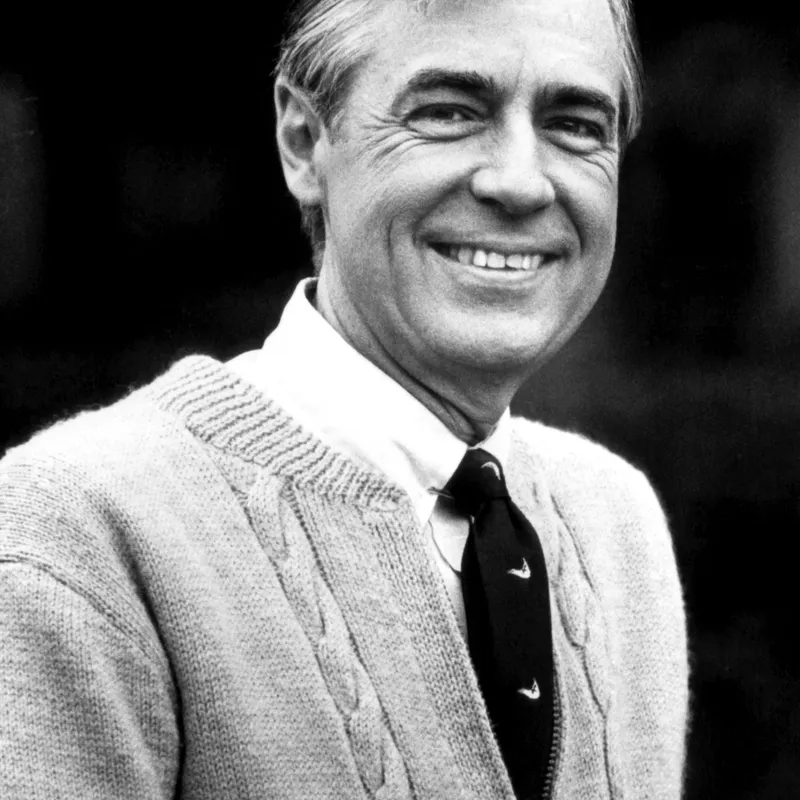
Fred McFeely Rogers
Television host, producer, and Presbyterian minister
of 100 · stable trend · Strong moral/spiritual alignment
Standing
83/100
Raw Score
69/85
Confidence
90%
Evidence
High
About
Fred Rogers built a decades-long public ministry through children's television, pairing explicit Christian formation with unusually concrete care for children's fears, feelings, and dignity.
The public record shows unusually high consistency between Rogers' stated moral vision and his long-term conduct, with the thinnest evidence areas being private financial charity and family-specific obligations rather than his public service.
Five Pillars
Pillar scores (0–100%)
Rogers scores especially high on observable social care, integrity, and conflict steadiness; the main limitations are thinner public evidence on private almsgiving and family-specific obligations rather than contradictory conduct.
Goodness over time
Starts at 100 at birth, natural decay after accountability age, timeline events adjust the trajectory.
17 Criteria Scores
Individual item scores (0–5) with evidence notes
Core Worldview
Ordained Presbyterian minister with explicit theistic ministry.
Public Christian teaching implies strong moral accountability, though not always in doctrinal detail.
His ministry consistently assumed transcendent moral order and human worth.
He described media work as a Christian calling shaped by scripture and church life.
Evidence supports scripturally formed modeling, though public discussion used broader Christian language.
Contribution to Others
Public evidence on family-specific obligations is real but thinner than his child-facing public service.
His life work centered emotionally vulnerable children, including those lacking stable adult support.
Public broadcasting and accessible child education disproportionately served families with fewer resources.
His recurring focus was children who felt isolated, ashamed, frightened, or excluded.
He answered public need with repeated direct explanations, letters, testimony, and child-centered programming.
His work pushed against racial exclusion and emotional repression in age-appropriate ways.
Personal Discipline
Church records and colleagues support regular prayer and disciplined devotional life.
Public evidence of disciplined giving exists indirectly through ministry, but not with the same specificity as his public service.
Reliability
His message, manner, and decades of delivery show unusually high reliability.
Stability Under Pressure
Evidence on personal financial strain is limited, though he defended underfunded public-interest media patiently.
Public accounts portray steadiness through illness, grief contexts, and emotionally difficult subject matter.
His Senate testimony and civil-rights-era choices show calm moral courage under pressure.
Timeline
Key events and documented turning points
Begins public television work at WQED
Rogers chose early work in educational television and began building the media vocation he later described as ministry to children and families.
→ Established the professional path that later became Mister Rogers' Neighborhood.
mediumOrdained as a Presbyterian minister for media ministry
Pittsburgh Presbytery ordained Rogers in 1962 with a charge to continue serving children and families through television rather than a traditional pulpit.
→ Made his television work an explicit religious and moral commitment rather than only a career choice.
highMister Rogers' Neighborhood launches nationally
The program premiered nationally and became Rogers' main vehicle for direct moral, emotional, and educational care for children.
→ Created a durable public platform for child-centered teaching rooted in acceptance, emotional literacy, and calm discipline.
highDefends public broadcasting before the U.S. Senate
When proposed federal funding cuts threatened public broadcasting, Rogers calmly argued that children deserved humane television and helped preserve support for the medium.
→ Strengthened the survival and legitimacy of publicly funded children's programming under budget pressure.
highUses Officer Clemmons pool scene to model racial inclusion
Rogers and François Clemmons used a simple shared pool scene to push against a segregation-era social taboo and make inclusivity visible to children.
→ Turned a children's program into a quiet but concrete act of social inclusion.
highSustains a long run of emotionally serious children's programming
Across decades, Rogers repeatedly addressed death, divorce, disability, fear, violence, and self-worth rather than retreating into shallow reassurance.
→ Built a durable public record of practical care for children under ordinary and crisis conditions.
highPressure Tests
Behavior under crisis or scrutiny
National trauma after Robert Kennedy's assassination
1968Rogers recognized that children were absorbing public violence and confusion from television news.
Response: He produced a special for adults urging them to protect children and explain frightening events honestly.
positiveSenate funding fight for public broadcasting
1969Federal support for public broadcasting was threatened by a proposed reduction in funding.
Response: Rogers responded with calm, concrete, child-focused testimony instead of public rage or self-protection.
positiveCivil-rights era pressure around integration
1969The social environment still treated interracial shared spaces, including pools, as politically charged.
Response: Rogers staged an intentionally inclusive pool scene with Officer Clemmons and normalized neighborly equality for children.
positiveProgression
crisis years
Public pressure increased, but his response stayed composed and child-centered.
steadycurrent stage
The record is historically settled and remains strongly positive.
stableearly years
A shy but musically gifted young broadcaster moved toward child-focused educational media.
forminggrowth years
Ordination and national television fused into a sustained public ministry.
improvingBehavioral Patterns
Positive
- • Repeatedly aligned public message with long-term personal conduct
- • Used a mass medium to dignify vulnerable children rather than manipulate them
- • Modeled racial inclusion and emotional honesty in culturally tense moments
Concerns
- • Observable giving is stronger in public pedagogy than in documented personal financial philanthropy
- • Some critique of his affirmation language exists, but it is more ideological reaction than evidence of harm
Evidence Quality
7
Strong
2
Medium
1
Weak
Overall: high
This profile measures public behavior and evidence patterns, not hidden intention, private salvation, or total moral worth.