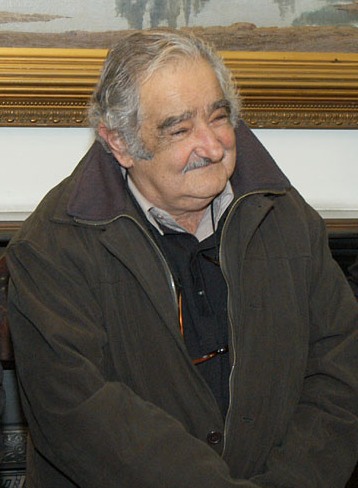
José Alberto Mujica Cordano
Former President of Uruguay, farmer, and former Tupamaro militant turned democratic politician
of 100 · stable trend · Some good traits but inconsistent
Standing
50/100
Raw Score
41/85
Confidence
76%
Evidence
Strong
About
José Mujica combined unusual personal austerity, repeated charity, and broad public concern for the poor with a clear secular worldview and the unresolved moral burden of his early participation in armed revolutionary violence.
The strongest observable pattern is that Mujica often lived below privilege, gave away money, widened civic protections, and endured hardship without sliding into corruption or luxury. He does not score higher in this framework because he publicly identified as nonreligious and because his public story begins with violence before democratic recovery.
Five Pillars
Pillar scores (0–100%)
Mujica's public record is strongest on modest living, generosity, democratic recovery, and endurance under prison and illness. The main constraints are explicit nonbelief, little evidence of God-centered worship, and the lasting stain of armed insurgency in his early career.
Goodness over time
Starts at 100 at birth, natural decay after accountability age, timeline events adjust the trajectory.
17 Criteria Scores
Individual item scores (0–5) with evidence notes
Core Worldview
Associated Press described Mujica in 2023 as Uruguay's best-known atheist.
He spoke often about moral limits and responsibility, but not through a clear afterlife-centered framework.
His public philosophy suggested meaning beyond consumption, but not a clearly theistic metaphysic.
No public record shows him orienting life around revealed scripture; the stronger evidence points the other way.
He sometimes used moral exemplars in broad humanist terms, but not in a prophet-centered way.
Contribution to Others
Public evidence centers civic service more than family-specific support.
His policies and public messaging often addressed the future of young people, but not mainly through orphan-focused work.
Salary donation, anti-poverty politics, and repeated concern for ordinary Uruguayans make this one of his strongest items.
His public language consistently defended dispossessed and excluded people beyond his immediate circle.
He remained unusually accessible in tone and gave away personal income in ways aimed at people with immediate need.
His reform record aimed to expand civil freedom and reduce coercive poverty rather than intensify social control.
Personal Discipline
The public record points to atheism or nonreligion rather than sustained theistic worship.
He gave away most of his salary to charity, but the evidence does not tie that discipline to God-centered obligation.
Reliability
His humble lifestyle aligned closely with his rhetoric, though his violent early politics and occasional bluntness prevent a top score.
Stability Under Pressure
He modeled voluntary material simplicity and stayed publicly comfortable with modest living.
Long imprisonment and late-life cancer were met with notable steadiness and public composure.
He endured major conflict and political pressure, though the early militant phase complicates how fully this counts as virtuous patience.
Timeline
Key events and documented turning points
Joined the Tupamaros guerrilla movement during Uruguay's political radicalization
Mujica became part of an armed revolutionary organization that used kidnappings, robberies, and attacks in the name of socialist change.
→ The decision tied him to violent tactics that remained a lasting moral stain even after his democratic reinvention.
highSpent nearly 15 years imprisoned, including long stretches in solitary confinement under dictatorship
After the collapse of the guerrilla campaign and the rise of military rule, Mujica was held for years in brutal conditions and treated as a hostage of the regime.
→ The prison years became the clearest public proof of endurance and later helped frame his anti-hatred philosophy.
highWon Uruguay's presidency through democratic politics after decades in legal public life
After release from prison and years in the Broad Front coalition, Mujica won the 2009 runoff and entered office in March 2010.
→ His election marked a nationally visible transition from insurgency to constitutional leadership.
highRejected presidential luxury and donated most of his salary to charity while in office
Mujica stayed on his modest farm, declined the presidential mansion, and directed most of his pay toward charitable causes and small entrepreneurs.
→ The choice strengthened public trust that his anti-consumerist language was not merely performative.
highUsed the Rio+20 platform to argue against consumerism and for human-centered development
At the global sustainability summit, Mujica argued that politics should serve human happiness and warned against societies built around endless consumption.
→ The speech made his secular moral philosophy internationally legible and reinforced his image as a plain-spoken critic of excess.
mediumBacked major social reforms while poverty fell and Uruguay's international standing rose
During his presidency, Uruguay legalized abortion, same-sex marriage, and marijuana while also drawing praise for democratic civility, alternative energy progress, and falling poverty.
→ The reform period strengthened his reputation for concrete social change, even while parts of the agenda stayed publicly contested.
highFaced terminal cancer publicly with resignation, plain speech, and continued civic loyalty
After announcing esophageal cancer in April 2024, Mujica later said the disease had spread and asked to be left in peace while still remaining symbolically present in public life.
→ The closing phase of the record reinforced steadiness and humility rather than self-dramatization.
mediumPressure Tests
Behavior under crisis or scrutiny
Dictatorship imprisonment
1972Mujica spent nearly 15 years imprisoned, including long stretches in solitary confinement as a hostage of Uruguay's dictatorship.
Response: He later described the prison years as a place of reflection rather than a permanent excuse for vengeance and returned to democratic politics after release.
strong_resilience_with_moral_reorientationPresidential power and scrutiny
2010He came to office carrying both symbolic admiration and fear because of his guerrilla past.
Response: He responded by living simply, donating money, and working across institutions rather than trying to dramatize power.
positive_under_powerTerminal illness
2025After cancer spread, he declined further treatment and publicly asked for privacy at the end of life.
Response: The closing phase of his record showed acceptance, modesty, and continued loyalty to his political community.
steady_under_personal_lossProgression
crisis years
The permanent tension in his record is that democratic humility coexists with an early history of revolutionary violence and later morally contested reforms.
mixedcurrent stage
Because Mujica died on 2025-05-13, the current stage is legacy evaluation: whether his simplicity and service outweigh his unbelief and violent beginnings in this framework.
stableearly years
A rural, modest upbringing fed both his suspicion of privilege and his early radical turn toward violent politics.
mixedgrowth years
After amnesty, Mujica rebuilt himself inside democratic institutions and gained unusual trust through personal simplicity.
upBehavioral Patterns
Positive
- • Personal austerity matched his public criticism of consumerism and elite privilege.
- • He converted a violent early life into a later democratic style that often emphasized mercy and ordinary dignity.
- • Repeated salary donation and farm living suggest that his anti-luxury message was not merely rhetorical.
Concerns
- • The Tupamaro period leaves real victims and a durable integrity problem that later simplicity does not cancel.
- • His explicit atheism leaves the belief and worship dimensions structurally weak under this framework.
Evidence Quality
6
Strong
2
Medium
0
Weak
Overall: strong
This profile evaluates observable public behavior and evidence, not the state of a person's soul.