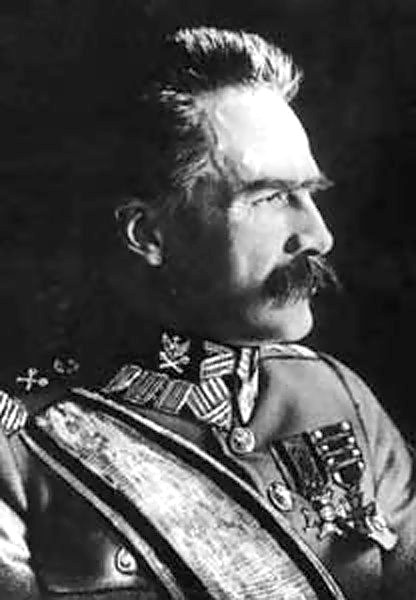
Józef Klemens Piłsudski
Polish revolutionary, marshal, and chief of state who shaped the Second Polish Republic
of 100 · stable trend · Some good traits but inconsistent
Standing
48/100
Raw Score
42/85
Confidence
74%
Evidence
Strong
About
Józef Piłsudski repeatedly accepted prison, exile, and war in pursuit of Polish independence, then helped build the state and repel the Red Army in 1920. The same record is morally narrowed by the 1926 coup, the 1930 Brest arrests, and thin public evidence of direct charity or disciplined private worship.
The observable pattern is historically consequential and mixed. Piłsudski clearly used power for national independence and at times for broader inclusion, but he also broke constitutional order and tolerated coercive politics when he believed the state was at risk.
Five Pillars
Pillar scores (0–100%)
Piłsudski's public record is strongest in resilience and the freeing of a nation from external domination: he accepted exile, prison, and war, helped build the Polish state, and resisted overt ethnic exclusion. The profile stays mixed because his later conduct crossed constitutional limits, the Brest affair damaged integrity badly, and direct evidence of personal worship and ordinary charity is much thinner than the record of statecraft and command.
Goodness over time
Starts at 100 at birth, natural decay after accountability age, timeline events adjust the trajectory.
17 Criteria Scores
Individual item scores (0–5) with evidence notes
Core Worldview
Public evidence suggests some moral-accountability language, but not a highly documented devotional life.
Catholic formation and later religious ties support a real but not fully documented theistic baseline.
Public record shows little strong evidence of prophetic modeling in his daily public conduct.
Religious identity is visible, but scripture-guided practice is not strongly documented in the public record.
He treated history and nationhood as morally charged, but the unseen dimension is not heavily evidenced.
Contribution to Others
The independence struggle is the clearest major public good in his record.
There is little strong evidence of direct sustained work for unsupported young people.
He did respond to delegations and allied groups, but the pattern is selective and political.
Family-level care is not strongly documented in the accessible public record.
PPS-linked social reforms and early state legislation support a moderate score.
His openness to minorities and federal alliances supports some positive evidence here.
Personal Discipline
Direct evidence of disciplined private charity is thin.
Public evidence supports religious identity more than clearly documented routine worship.
Reliability
His refusal in 1917 helps, but the 1926 coup and Brest arrests materially lower the integrity score.
Stability Under Pressure
War leadership and endurance under direct threat are among the strongest parts of his record.
His family experienced material decline, though the public record is not centered on prolonged poverty.
Exile and prison did not end his public work.
Timeline
Key events and documented turning points
Was exiled to Siberia after the tsarist plot case
Piłsudski was arrested in 1887 and sent to eastern Siberia for five years, an experience that hardened his anti-imperial politics and exposed him to veteran independence activists.
→ The exile deepened his commitment to national liberation rather than ending his public life.
mediumJoined the Polish Socialist Party and tied independence to social reform
After returning from exile, Piłsudski became a leading organizer of the newly founded Polish Socialist Party and edited Robotnik, treating independence and social reform as linked obligations.
→ His politics moved beyond patriotic symbolism toward organized action with a social program.
mediumAccepted imprisonment rather than subordinate Polish forces without sovereignty
During the Oath Crisis, Piłsudski refused to let Polish units swear loyalty without a sovereign Polish state and was imprisoned by the Germans at Magdeburg.
→ The refusal strengthened his image as a leader who would not trade autonomy for expedience.
highTook charge of the reborn state and backed democratic and social legislation
After returning to Warsaw in November 1918, Piłsudski assumed military and then civilian authority, built the core of the Polish Army, and backed a government that laid democratic and social-legislation foundations for the new republic.
→ He converted underground prestige into functioning state authority with broad public consequences.
highMet Jewish leaders and rejected overt discrimination
Piłsudski met a delegation of Jewish politicians immediately after his return from Magdeburg and publicly signaled opposition to antisemitic exclusion, even though his interest in minority welfare remained limited.
→ He set a more inclusive tone than the openly antisemitic National Democrat current, without building a full minority-rights program.
mediumHelped preserve Polish independence in the 1920 war while pursuing a federal vision eastward
Piłsudski pursued an alliance with Symon Petliura and then directed the August 1920 maneuver that turned back the Red Army near Warsaw, even though the later Treaty of Riga ended the broader federal project he wanted in the east.
→ The victory preserved Poland, but the incomplete federal outcome left a morally mixed eastern legacy.
highOverthrew the constitutional government in the May Coup
Concluding that parliamentary politics was failing, Piłsudski marched on Warsaw in May 1926; the three-day coup killed hundreds and replaced constitutional transfer of power with force.
→ His return to power stabilized some state functions but damaged democratic legitimacy and normalized extra-constitutional rule.
highOrdered the Brest arrests of opposition leaders
In 1930 Piłsudski ordered the arrest of Centrolew opposition leaders and their imprisonment in Brest, where they were brutally treated before politically charged trials.
→ The episode became a durable stain on the Sanation regime and reinforced the authoritarian turn of his rule.
highPressure Tests
Behavior under crisis or scrutiny
Siberian exile
1887Tsarist authorities sent Piłsudski to eastern Siberia for five years after the Alexander III plot case.
Response: He emerged more committed to independence politics instead of withdrawing from public struggle.
positiveMagdeburg imprisonment after the Oath Crisis
1917Germany imprisoned Piłsudski after he refused to let Polish forces swear loyalty without a sovereign Polish state.
Response: He accepted imprisonment rather than trade away political independence for short-term military advantage.
positiveDomestic political breakdown and his return to power
1926Facing parliamentary crisis, Piłsudski chose an armed coup and later backed coercive measures against opponents.
Response: Under internal pressure he showed resolve, but not constitutional patience; the stress response protected his agenda while damaging trust and restraint.
negativeProgression
crisis years
The same determination that built the state hardened into constitutional impatience and coercive rule.
mixedcurrent stage
His legacy remains that of a founding father with genuine courage and institution-building weight, but not a clean moral model because the republic he helped save was also bent by his later authoritarian choices.
stableearly years
A patriotic noble-household upbringing turned into anti-tsar activism, exile, and disciplined underground politics.
upgrowth years
His influence expanded from conspiratorial organizer to military founder and national leader of the reborn state.
upBehavioral Patterns
Positive
- • Repeatedly accepted prison, exile, and military danger for the independence cause.
- • Used national leadership to build institutions rather than only symbolic rhetoric.
- • Was more open than many contemporaries to minority equality and a broader federal vision in the east.
Concerns
- • Crossed from corrective ambition into extra-constitutional force in 1926.
- • Accepted repression of political opponents in 1930 and left an authoritarian stain on the republic.
Evidence Quality
8
Strong
2
Medium
0
Weak
Overall: strong
This profile evaluates observable public behavior and evidence, not the state of a person's soul.