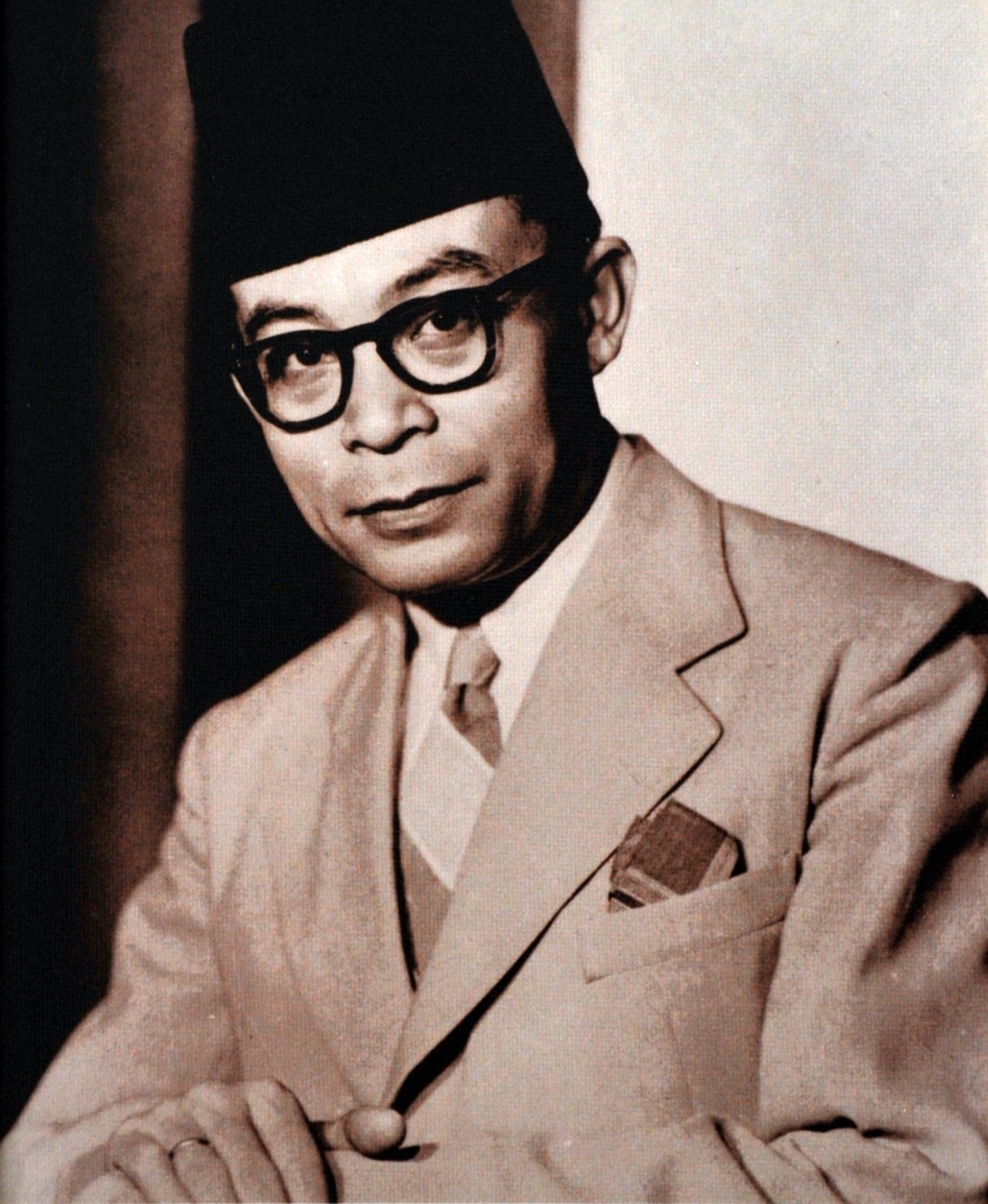
Mohammad Hatta
Indonesian nationalist leader, co-proclaimer of independence, first vice president, and former prime minister
of 100 · stable trend · Strong moral/spiritual alignment
Standing
85/100
Raw Score
72/85
Confidence
81%
Evidence
High
About
Mohammad Hatta helped build modern Indonesia through disciplined nationalist organizing, exile-tested endurance, cooperative economics, and a sustained reputation for personal integrity. The main caution is that his record still includes morally gray collaboration with Japanese occupation structures and hard coercive choices during revolutionary state-building.
The observable pattern is strongly constructive. Hatta repeatedly chose disciplined service over charismatic domination, accepted hardship without retreating from public duty, and later criticized corruption and guided democracy from a principled position. He does not score as rare excellence because private-family obligations are thinly documented and his legacy is not free of wartime and coercive-state compromises.
Five Pillars
Pillar scores (0–100%)
Hatta's strongest public proof is disciplined nation-building under pressure: exile did not break him, he repeatedly oriented politics toward public responsibility, and his reputation for integrity remained durable enough to make anti-corruption part of his later legacy. The score stays below rare excellence because public evidence is thin on family-specific care and because his record still includes morally difficult collaboration with Japanese occupation structures and forceful state action during the revolution.
Goodness over time
Starts at 100 at birth, natural decay after accountability age, timeline events adjust the trajectory.
17 Criteria Scores
Individual item scores (0–5) with evidence notes
Core Worldview
Public scholarship describes Hatta as a religious nationalist from a devout Muslim background.
His political thought is repeatedly described as morally disciplined rather than merely tactical.
His public record reflects a stable moral framework shaped by religion as well as nationalism.
The public record supports treating him as a Muslim whose thought remained informed by Islam.
Scholarly work links his conduct and ideas to Islamic ethical commitments even when he rejected an Islamic state.
Contribution to Others
Public evidence is thin on kin-specific help.
The Banda Naira school shows direct care for young people outside formal power.
His cooperative-economic legacy aimed at ordinary people rather than elite capture.
His public service consistently ran beyond kin and faction to broader Indonesian publics.
The exile-school example shows practical response to visible local need.
Anti-colonial organizing and sovereignty-building are central freeing actions in the record.
Personal Discipline
As a publicly evidenced Muslim, he receives the best-assumption score absent contrary evidence.
As a publicly evidenced Muslim, he receives the best-assumption score absent contrary evidence.
Reliability
Resignation over guided democracy and a durable anti-corruption reputation support a strong score, but wartime and revolutionary compromises prevent a 5.
Stability Under Pressure
He was deeply focused on economic hardship and austere public service, though personal-finance evidence is limited.
Prison, malaria, and exile did not break his discipline.
He stayed active through occupation, revolutionary crisis, and a principled break with Sukarno.
Timeline
Key events and documented turning points
Became a leading organizer in Perhimpunan Indonesia while studying in the Netherlands
During his student years in the Netherlands, Hatta led Perhimpunan Indonesia and helped internationalize the Indonesian independence cause.
→ Helped build a disciplined overseas nationalist network and a long-horizon strategy for independence.
highWas exiled by the Dutch to Boven Digul and later Banda Naira for nationalist activity
After arrest by Dutch colonial authorities, Hatta was sent into harsh exile, first in Boven Digul and later in Banda Naira, where illness and isolation tested his endurance.
→ The exile deepened his reputation for disciplined resilience rather than breaking his political commitment.
highHelped create an afternoon school for Banda children during exile
While exiled in Banda Naira, Hatta and Sutan Sjahrir opened a Kelas Sore for local children and taught religious ethics, integrity, and nationalism.
→ Turned exile into a practical act of local service and moral education.
mediumWorked with Japanese-sponsored mass organizations and helped organize PETA
Under Japanese occupation, Hatta collaborated with Japanese-backed organizations and assisted in building the PETA home-defense force, a choice later defended as strategic but still morally complicated.
→ Expanded nationalist organizational capacity while leaving a durable ambiguity about using occupier-backed structures.
mediumCo-proclaimed Indonesian independence with Sukarno
After urging patience until Japanese defeat was certain, Hatta stood with Sukarno on 17 August 1945 and signed the proclamation of Indonesian independence.
→ Established him as one of the central founders of the Republic of Indonesia.
highAs prime minister, helped suppress the Madiun communist revolt
During a fragile revolutionary period, Hatta played an important part in the suppression of the communist revolt at Madiun in eastern Java.
→ Strengthened the republic's standing with Western backers but linked Hatta's legacy to coercive revolutionary-state action.
highLed the delegation to the Hague Conference that secured Dutch recognition of independence
Hatta led Indonesia's delegation at the Hague Conference, which culminated in Dutch recognition of Indonesia's complete independence.
→ Helped convert revolutionary struggle into internationally recognized sovereignty.
highResigned as vice president over disagreement with Sukarno's guided democracy
Hatta resigned rather than support Sukarno's move toward guided democracy, criticizing the concentration of power and the neglect of Indonesia's economic realities.
→ Preserved his reputation for principled restraint even as it reduced his direct influence inside the state.
highReturned from retirement to advise on government corruption after Sukarno's fall
After Sukarno's downfall, Hatta re-entered public life as a special adviser to President Suharto on corruption, reinforcing his identity as a clean-government reference point.
→ Strengthened his later-life image as an integrity benchmark, even though the wider anti-corruption push had limited structural success.
mediumPressure Tests
Behavior under crisis or scrutiny
Dutch colonial exile
1935Dutch authorities imprisoned and exiled Hatta to Boven Digul and Banda Naira for nationalist activism.
Response: He did not retreat from public purpose and turned exile into disciplined study, teaching, and continued moral formation.
positiveJapanese occupation collaboration
1943Occupation authorities promoted Indonesian nationalism through controlled organizations in which Hatta participated.
Response: He treated collaboration as a route toward later independence, but the choice remains morally mixed because it relied on occupier-backed structures.
mixedBreak with guided democracy
1956Sukarno's move toward guided democracy pressured Hatta to stay inside a more centralized and charismatic system.
Response: He resigned instead of lending his name to a direction he believed was damaging the republic.
positiveProgression
crisis years
Prison, exile, occupation, and revolution tested whether his principles would survive pressure.
steady_under_pressurecurrent stage
His present historical legacy is stable: admired for integrity and restraint, but still read through wartime and revolutionary compromises.
stableearly years
Student activism and disciplined intellectual formation turned Hatta into an international organizer for Indonesian independence.
upgrowth years
State-building, diplomacy, and cooperative economics broadened his legacy beyond protest into institutional design.
mixed_positiveBehavioral Patterns
Positive
- • Repeated preference for disciplined institution-building over personality cult politics.
- • Consistent outward concern for national self-rule and cooperative economic justice.
Concerns
- • Occupation-era collaboration remains a permanent interpretive caution in the record.
- • State-preserving coercion during the revolution complicates an otherwise high-integrity public image.
Evidence Quality
5
Strong
3
Medium
0
Weak
Overall: high
This profile evaluates observable public behavior and evidence, not the state of a person's soul.