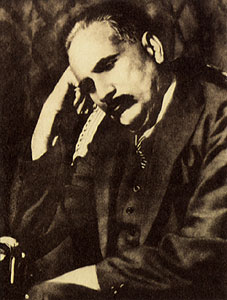
Muhammad Iqbal
Poet, philosopher, lawyer, and Muslim political thinker
of 100 · stable trend · Strong moral/spiritual alignment
Standing
82/100
Raw Score
69/85
Confidence
67%
Evidence
Strong
About
Iqbal used poetry, philosophy, and politics to call Indian Muslims toward moral renewal, educational reform, and collective self-respect. The strongest caution is that his separate-state advocacy hardened communal politics and still carries a morally contested legacy.
The observable pattern is substantially constructive in belief, worship assumption, intellectual honesty, and long-run concern for communal uplift, especially through educational thought and orphan-support institutions. The profile stays under review because the public record is much stronger on ideas and collective influence than on private-family obligations, and because his political vision contributed to an exclusionary partition logic even while he framed it as cultural autonomy and protection.
Five Pillars
Pillar scores (0–100%)
Iqbal scores highest where the evidence is clearest: explicit Islamic belief, reformist worship assumptions, and sustained use of intellect and public reputation for communal uplift. The score remains below exemplary because direct evidence of family-level care and routine private charity is thin, and his separate-state politics remain a serious contested feature of the public record.
Goodness over time
Starts at 100 at birth, natural decay after accountability age, timeline events adjust the trajectory.
17 Criteria Scores
Individual item scores (0–5) with evidence notes
Core Worldview
Public record clearly identifies Iqbal as a Muslim thinker whose work is explicitly theocentric.
He consistently wrote as though moral life is answerable to God and beyond worldly power.
His philosophy of selfhood, destiny, and revelation assumes a morally ordered universe.
Reconstruction and his poetry repeatedly treat Quranic guidance as authoritative for public life.
He explicitly presents the Prophet as a model for social order and moral renewal.
Contribution to Others
The public record is thin on family-specific care, so this stays cautious rather than punitive.
Leadership tied to Dar-ul-Shafqat gives concrete evidence of concern for vulnerable children.
His writing and public program repeatedly addressed Muslim decline, debt, and social backwardness.
There is some broad evidence of concern for the marginalized, but little direct case-specific proof.
Much of his political turn answered explicit communal anxieties voiced by Indian Muslims.
Educational reform and self-determination were central to his attempt to loosen colonial and communal subordination.
Personal Discipline
Under the Muslim assumption-of-best rule, there is no meaningful public counterevidence to strong practice.
Under the Muslim assumption-of-best rule, there is no meaningful public counterevidence to disciplined giving.
Reliability
His record shows unusual candor and steadiness in public commitments, though his politics had serious downstream costs.
Stability Under Pressure
Evidence on his personal finances is limited, but his work stayed focused on patient reform rather than quick gain.
He continued writing and institution-building through prolonged illness.
He stayed publicly engaged during high-pressure communal and imperial negotiations.
Timeline
Key events and documented turning points
Completed advanced study at Government College Lahore and emerged as a public poet
Iqbal completed higher study in philosophy and law in Lahore, where teachers such as Mir Hasan and Thomas Arnold helped shape his Islamic literary grounding and philosophical range.
→ This period gave him the intellectual tools and public voice that would define his later reformist role.
mediumReturned to Lahore after Cambridge, Middle Temple, and Munich training
After study in Cambridge, legal training in London, and a Munich doctorate, Iqbal returned to Lahore to teach and practice law while deepening his Islamic philosophical project.
→ He chose synthesis over imitation, strengthening his later authority in education and reform debates.
mediumPublished Asrar-i Khudi and made selfhood central to Muslim reform
The Persian work Asrar-i Khudi presented disciplined selfhood as a path out of stagnation and helped establish Iqbal as a poet-philosopher of moral awakening.
→ Iqbal's moral vocabulary reached far beyond local literary circles and became a durable part of modern Islamic thought.
highDelivered the Allahabad Address calling for a consolidated Muslim state in northwestern India
As Muslim League president, Iqbal argued that Muslims were a distinct political community and called for a consolidated Muslim-majority state, while also saying it was a Quranic duty to defend other communities' places of worship.
→ The address became a landmark in Pakistan's founding story, but it also deepened a communal political logic that remains morally contested.
highRepresented Muslim interests at the Round Table Conferences in London
Iqbal carried Muslim constitutional demands into high-pressure imperial negotiations and repeated key themes of autonomy, representation, and cultural self-determination.
→ He remained publicly steady under elite political pressure, though the underlying communal divide remained unresolved.
mediumPublished The Reconstruction of Religious Thought in Islam
Building on lectures from 1928 to 1929, Iqbal argued that Muslims should use ijtihad to renew social and political institutions without surrendering revelation to secular nationalism.
→ The work became one of his clearest statements of belief, accountability, and principled institutional change.
highLed Anjuman Himayat-i-Islam during a period tied to Dar-ul-Shafqat welfare work
Anjuman Himayat-i-Islam's current institutional history identifies Iqbal as president from 1934 to 1937 and links the organization to free or affordable education and care for vulnerable Muslim children through Dar-ul-Shafqat.
→ This is one of the clearest public proofs that his concern for uplift reached institutional care, not only poetry and speeches.
highHelped shape the Dar ul Islam Trust project for subsidized study
In his final years Iqbal helped Chaudhry Niaz Ali Khan establish the Dar ul Islam Trust vision for subsidized study in classical Islam and contemporary social science.
→ The project reflected his repeated effort to turn ideas about reform into institutions.
mediumDied after prolonged ill health before seeing Pakistan created
After years of illness, Iqbal died in Lahore in April 1938, leaving an unfinished political legacy that others carried into the 1947 partition settlement.
→ His death froze the record before any later correction, moderation, or direct accountability for partition-era outcomes could occur.
mediumPressure Tests
Behavior under crisis or scrutiny
Study and status pressure in Europe
1905Iqbal encountered elite Western education and law during colonial rule, a setting that could have pushed him toward imitation or deracination.
Response: He returned with stronger confidence in using Western tools while arguing from within Islamic categories.
positiveCommunal and constitutional deadlock
1930The crisis of representation in late colonial India forced Muslim leaders to answer how a minority community could avoid domination.
Response: Iqbal answered with a firm public doctrine of Muslim political consolidation; this showed steadiness under pressure but produced a morally mixed outcome.
mixedFinal illness
1937His last years were marked by prolonged ill health while his public ideas were still carrying heavy political weight.
Response: He continued writing and helping shape educational institutions instead of disappearing from public duty.
positiveProgression
crisis years
Communal deadlock pushed him from cultural revivalism toward hard political territorial arguments.
mixedcurrent stage
His present-day legacy is stable but divided: morally serious, socially reformist, and politically contested.
stableearly years
Religious schooling and literary formation grounded Iqbal in Islamic languages before his later philosophical expansion.
upgrowth years
European study and major poetic works broadened his method while keeping him anchored in Muslim reform.
upBehavioral Patterns
Positive
- • Repeatedly treated Islam as a lived civilizational ethic tied to education, law, and social responsibility.
- • Turned literary prestige into reform arguments and institutional affiliation rather than private retreat.
- • Protected room, at least in principle, for other communities' worship even while arguing for Muslim political consolidation.
Concerns
- • Moved from broad Indian patriotism toward communal territorial politics, with lasting costs for plural coexistence.
- • Public evidence is not strong enough to rate domestic obligations or private almsgiving with high confidence.
Evidence Quality
6
Strong
3
Medium
0
Weak
Overall: strong
This profile evaluates observable public behavior and evidence, not the state of a person's soul.