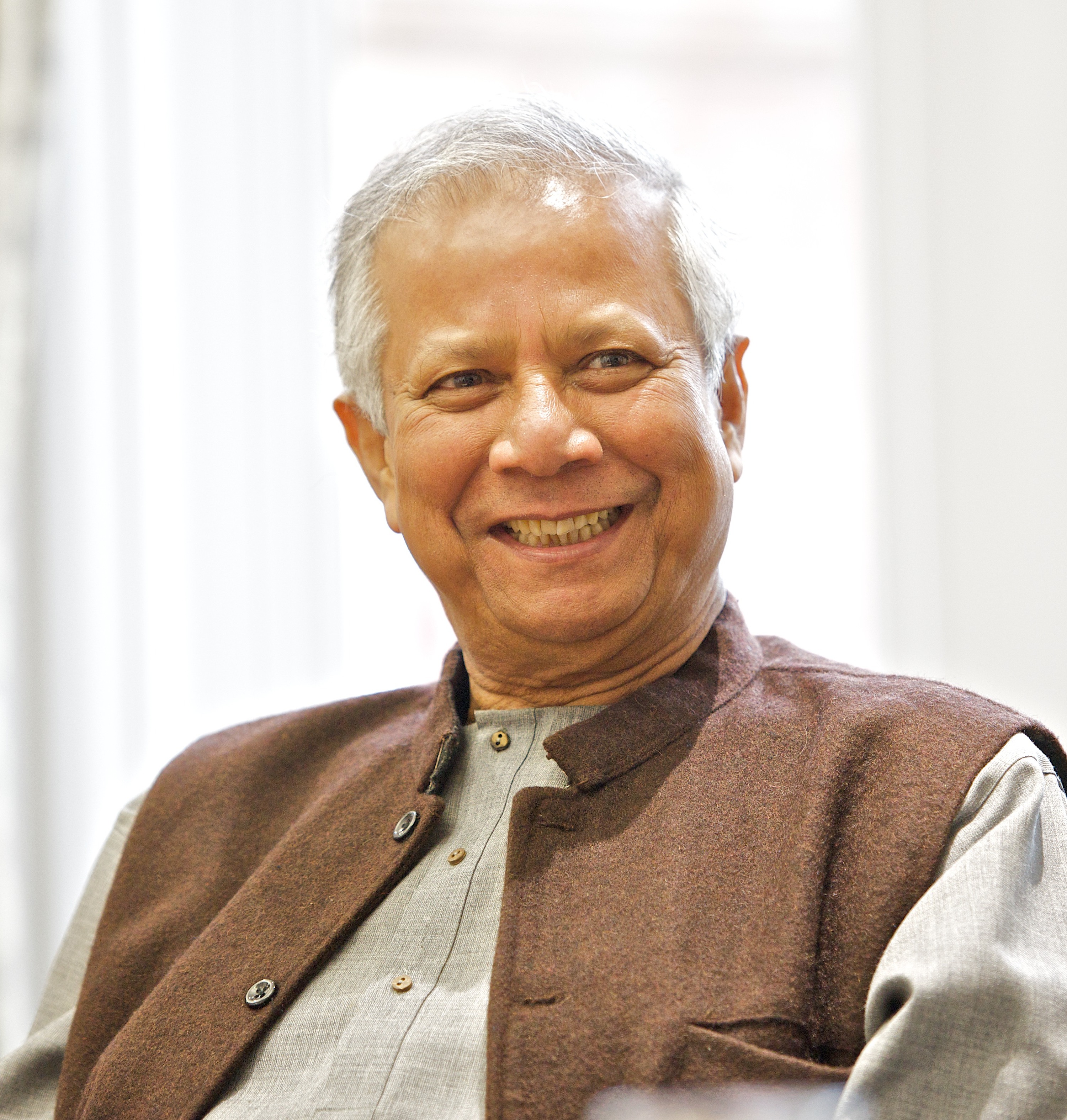
Muhammad Yunus
Economist, microfinance pioneer, founder of Grameen Bank, and Chief Adviser of Bangladesh's interim government
of 100 · improving trend · Visibly decent and improving
Standing
82/100
Raw Score
70/85
Confidence
72%
Evidence
Strong
About
Yunus built one of the world's most influential poverty-alleviation models by extending collateral-free credit to poor women and turning that experiment into Grameen Bank. The main caution points are a documented labor-law conviction in 2024 and long-running political and governance disputes that complicate an otherwise strongly prosocial public record.
The observable pattern is substantially constructive. His strongest public proof is repeated, large-scale practical help to poor and financially excluded people, especially women, paired with endurance through political retaliation and public pressure. The profile stays below exemplary because direct evidence of worship discipline is thin and integrity questions remain live around labor compliance and institutional conflict.
Five Pillars
Pillar scores (0–100%)
Yunus scores best where the evidence is clearest: repeated practical help to poor borrowers, especially women, and durable resilience under public pressure. The score remains well below exemplary because direct evidence of worship discipline is sparse and the 2024 labor-law conviction leaves a real integrity drag even if supporters view the wider case environment as political.
Goodness over time
Starts at 100 at birth, natural decay after accountability age, timeline events adjust the trajectory.
17 Criteria Scores
Individual item scores (0–5) with evidence notes
Core Worldview
Bangladeshi Muslim whose life work in microfinance is rooted in moral duty and service to the poor.
Repeatedly frames poverty alleviation as a moral obligation with consequences beyond economics.
His vision of a world without poverty reflects deep conviction in a just moral order.
Muslim upbringing and consistent moral framework aligned with Islamic principles of social justice.
His model of serving the poorest directly mirrors prophetic traditions of care for the vulnerable.
Contribution to Others
Public material focuses on civic rather than family-specific care.
His institutions created pathways that materially benefited young and unsupported households.
This is the clearest pattern in the record: repeated practical help to poor borrowers.
His work consistently reached socially excluded people outside his kin network.
The initial microcredit experiment began by responding to concrete requests and observed need.
Microcredit and social-business work aimed to loosen debt traps and structural exclusion.
Personal Discipline
Practising Muslim from Bangladesh with a life structured around discipline and moral commitment.
Dedicated his Nobel Prize money and personal resources to charitable institutions serving the poor.
Reliability
Mission consistency is strong, but labor-law and governance concerns prevent a higher score.
Stability Under Pressure
He persisted in scarcity-focused work over decades, though personal-finance evidence is limited.
He remained publicly active through legal pressure and institutional defeat.
Accepting interim leadership in a national crisis supports a strong pressure score.
Timeline
Key events and documented turning points
Started lending small sums to poor villagers in Jobra after the famine years
After seeing basket weavers trapped by tiny debts, Yunus personally lent small amounts to dozens of villagers near Chittagong University, launching the experiment that became microcredit.
→ Created a practical proof-of-concept for collateral-free lending to people excluded from formal finance.
highFounded Grameen Bank as an institutional home for microcredit
Yunus formalized the lending model by establishing Grameen Bank to provide small loans on accessible terms to poor borrowers without collateral.
→ Built a durable institution that scaled poverty-focused lending nationally and later inspired replications worldwide.
highShared the Nobel Peace Prize with Grameen Bank
The Nobel Committee recognized Yunus and Grameen Bank for creating economic and social development from below through microcredit.
→ Confirmed the global reach and perceived legitimacy of his anti-poverty model.
highLost his final appeal against removal from Grameen Bank leadership
Bangladesh's Supreme Court left in place the central bank order requiring Yunus to leave the managing director post at Grameen Bank.
→ Marked a major institutional setback and intensified the long-running conflict between Yunus and the Hasina-era state.
mediumWas convicted in a labor-law case involving Grameen Telecom
A Dhaka labor court sentenced Yunus and other officials to six months in jail over labor-law violations at Grameen Telecom; he denied wrongdoing and appealed.
→ Created a live integrity concern even as supporters argued the broader case pattern was politically motivated.
highAccepted leadership of Bangladesh's interim government after the uprising
After initially hesitating, Yunus agreed to serve as chief adviser and was sworn in as head of the interim government during a volatile national transition.
→ Returned him to direct national responsibility and raised the stakes for judging whether his moral language can survive executive pressure.
highPressure Tests
Behavior under crisis or scrutiny
Removal from Grameen Bank leadership
2011The state-backed removal from the bank he founded ended his formal leadership there after legal appeals failed.
Response: He continued public advocacy around social business and did not disappear from civic life.
positiveLabor-law conviction
2024A Dhaka labor court convicted Yunus and other officials over labor-law violations at Grameen Telecom.
Response: He denied wrongdoing and appealed, keeping the dispute in the category of active public contest rather than settled moral exoneration.
mixedInterim-government leadership
2024Student leaders and a shaken national system asked him to lead during a dangerous political transition.
Response: After initial hesitation, he agreed to take responsibility and entered a high-pressure governing role.
positiveProgression
crisis years
Conflict with the Bangladeshi state and courts turned him from a celebrated reformer into a polarizing national figure.
mixedcurrent stage
His current phase tests whether a celebrated social innovator can translate reputation into trustworthy national stewardship.
upearly years
Academic economics gave way to direct experimentation after he encountered famine-era village poverty up close.
upgrowth years
The microcredit experiment became an institution with global replication and symbolic force.
upBehavioral Patterns
Positive
- • Turned direct contact with poor borrowers into long-lived institutions rather than one-off charity.
- • Centered women's access to capital as a route to household stability and dignity.
- • Repeatedly accepted public scrutiny and personal risk instead of retreating from contested roles.
Concerns
- • Governance and labor-compliance questions complicate an otherwise high-impact social record.
- • Public evidence is thin on explicitly Islamic devotional discipline and family-specific care.
Evidence Quality
7
Strong
2
Medium
0
Weak
Overall: strong
This profile evaluates observable public behavior and evidence, not the state of a person's soul.