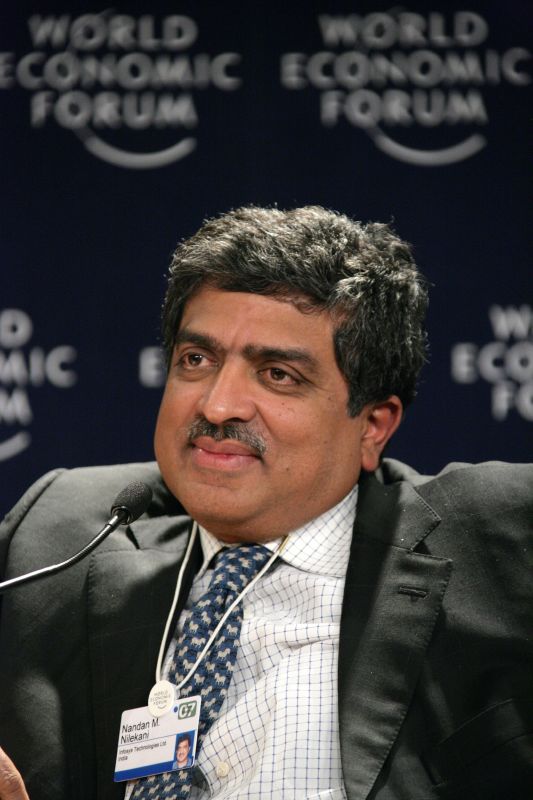
Nandan Nilekani
Co-founder and chairman of Infosys; former founding chair of UIDAI; philanthropist and digital public infrastructure advocate
of 100 · stable trend · Visibly decent and improving
Standing
61/100
Raw Score
50/85
Confidence
65%
Evidence
Strong with material contested areas
About
Indian technology founder and philanthropist whose public record shows repeated institution-building for education, identity, and financial inclusion at population scale.
The strongest evidence supports large-scale social contribution, long-range execution, and a genuine public-interest orientation. The main caution is that Aadhaar's privacy, surveillance, and exclusion risks remain a material part of his public record, so integrity and social-care claims cannot be treated as unambiguously clean.
Five Pillars
Pillar scores (0–100%)
Raw score 50 out of 85 and weighted score 60.5 out of 100. The public record supports meaningful goodness through institution-building, philanthropy, and sustained public commitments, but the Aadhaar record is materially contested and devotional evidence is limited.
Goodness over time
Starts at 100 at birth, natural decay after accountability age, timeline events adjust the trajectory.
17 Criteria Scores
Individual item scores (0–5) with evidence notes
Core Worldview
Public record shows theistic and duty-oriented language, but not specifically Islamic creed.
Public statements show moral accountability and duty more clearly than eschatological detail.
He regularly frames society through systems, duty, and moral order rather than pure materialism.
The Giving Pledge letter explicitly references scriptural guidance from the Bhagavad Gita.
Public evidence for prophet-centered emulation is thin.
Contribution to Others
Little strong public evidence about this dimension.
EkStep and education work strongly target childrens learning opportunity.
Aadhaar, Avanti, and philanthropy were repeatedly framed around inclusion and access.
His public-goods work aims at broad access beyond familiar circles.
Giving is visible, but the public record is stronger on systems than direct-response aid.
Digital identity and affordable credit were framed as tools against exclusion and friction.
Personal Discipline
Reliable public evidence is limited.
Large public charitable commitments are strongly evidenced.
Reliability
Long-range execution is strong, but Aadhaar criticism keeps this below the highest mark.
Stability Under Pressure
Limited direct evidence.
He absorbed public defeat and criticism without visible collapse or retaliation.
He stayed publicly engaged through sharp Aadhaar controversy and political loss.
Timeline
Key events and documented turning points
Co-founded Infosys
Nilekani became one of the seven co-founders of Infosys, helping build one of India's most influential technology companies over the following decades.
→ Created a durable institution that expanded skilled employment and gave Nilekani the platform later used for public-interest work.
highLeft Infosys leadership to chair UIDAI
He resigned from Infosys board leadership after being invited by the prime minister to lead the Unique Identification Authority of India in cabinet rank.
→ Shifted from private-sector leadership into a public project framed as improving inclusion and state capacity.
highLed Aadhaar's early rollout as a national identity platform
Under Nilekani's UIDAI leadership, Aadhaar moved from concept to the world's largest biometric identity program, promoted as a tool for inclusion, welfare delivery, and cleaner administration.
→ Produced a vast digital-public-infrastructure system with major inclusion claims and long-term consequences for citizen-state interaction.
highLost his parliamentary election in Bangalore South
After entering electoral politics with the Indian National Congress, Nilekani lost his first parliamentary race and publicly accepted the defeat without visible escalation.
→ His direct political bid failed, but the public response was restrained rather than bitter.
mediumHelped launch Avanti Finance for underserved borrowers
Nilekani joined Tata Trusts and others to launch Avanti Finance, aimed at timely and affordable credit for underserved and unserved communities, with gains intended for philanthropy.
→ Extended his public-interest technology work into financial inclusion beyond identity infrastructure.
highJoined the Giving Pledge with Rohini Nilekani
Nandan and Rohini Nilekani publicly pledged to give the majority of their wealth to charitable causes and framed the commitment as a duty-oriented moral obligation.
→ Converted philanthropic identity into an explicit long-term public commitment rather than ad hoc generosity.
highAadhaar survived legally but privacy and exclusion criticisms remained central
The Supreme Court upheld core parts of Aadhaar while limiting some uses. Critics continued to argue that the system carried surveillance, privacy, and exclusion risks, even as Nilekani described the ruling as validation of Aadhaar's founding principles.
→ The program remained influential, but its moral and governance record stayed contested rather than fully vindicated.
highMade a record Rs. 315 crore gift to IIT Bombay
Nilekani signed a major multi-year donation to IIT Bombay, described by the institute as the largest private donation made in India to an academic institution, while leaving the use of funds largely untied.
→ Reinforced a strong public pattern of giving toward education and institution-building.
highPressure Tests
Behavior under crisis or scrutiny
Shift from elite corporate role to UIDAI
2009He left a powerful private-sector role for a difficult public identity project with enormous implementation and political risk.
Response: He accepted the assignment and stayed associated with the program through years of criticism.
positiveParliamentary election defeat
2014His political debut ended in a clear loss in Bangalore South.
Response: He publicly accepted the result without visible grievance politics.
positiveAadhaar privacy and exclusion backlash
2018The program faced Supreme Court scrutiny and enduring criticism over surveillance, data security, and exclusion.
Response: He continued defending Aadhaar's core design while accepting that security and legal protections mattered.
mixedProgression
crisis years
The largest strain on the record comes from Aadhaar's privacy and exclusion debate rather than from personal scandal.
mixedcurrent stage
Recent years continue the institution-building and philanthropy pattern while leaving Aadhaar's moral ambiguity unresolved.
stableearly years
Technical and managerial credibility formed first through company-building rather than public office.
upgrowth years
Private-sector success widened into population-scale public infrastructure and education work.
upBehavioral Patterns
Positive
- • Builds durable institutions instead of relying only on speech or branding.
- • Commits large resources to education, social infrastructure, and public-interest technology.
- • Usually presents social progress as a systems problem requiring broad access, not just elite consumption.
Concerns
- • Aadhaar's scale makes errors and privacy harms morally weighty, especially for vulnerable users.
- • Public devotion and private spiritual discipline are lightly evidenced compared with public achievement.
Evidence Quality
13
Strong
4
Medium
0
Weak
Overall: strong_with_material_contested_areas
This profile evaluates observable conduct and public evidence, not the unseen state of a person's soul.