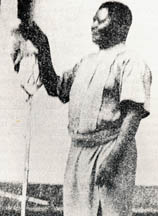
Simon Kimbangu
Congolese religious leader, Baptist catechist, and founding figure of Kimbanguism
of 100 · stable trend · Strong moral/spiritual alignment
Standing
80/100
Raw Score
67/85
Confidence
76%
Evidence
Strong
About
Simon Kimbangu's public record centers on a five-month healing and preaching ministry in 1921, a nonviolent response to colonial repression, and a legacy that outlived thirty years of imprisonment.
The evidence supports a strong moral-spiritual legacy with medium confidence: his belief, worship discipline, and resilience are unusually clear, while some social-care details remain thinner because the archival record is old and brief.
Five Pillars
Pillar scores (0–100%)
The public record shows unusually strong belief, devotion, and resilience, anchored in a short but high-impact ministry and decades of nonviolent endurance under colonial repression.
Goodness over time
Starts at 100 at birth, natural decay after accountability age, timeline events adjust the trajectory.
17 Criteria Scores
Individual item scores (0–5) with evidence notes
Core Worldview
His entire public mission was framed as obedience to God and Jesus.
His preaching and moral discipline imply clear accountability before God.
The public record repeatedly centers visions, prayer, prophecy, and divine calling.
He was a Baptist catechist whose authority rested on biblical teaching.
Accounts describe him consciously modeling himself on Christ during trial and imprisonment.
Contribution to Others
Public sources say little about family support beyond the later work of his wife and sons.
His movement served vulnerable people broadly, but youth-specific care is not a central documented pattern.
Healing, moral care, and liberation language consistently centered oppressed Congolese people.
Crowds traveled from across the Congo and Angola to seek help, and his ministry did not stay confined to kin.
The movement grew around direct responses to sick and desperate people who came to him for help.
His message of spiritual and political liberation clearly aimed at freeing people from colonial and moral bondage.
Personal Discipline
His public life shows sustained prayer, catechesis, preaching, and spiritual retreat.
Direct almsgiving records are thin, but disciplined service to needy believers supports a positive analogue score.
Reliability
The strongest observable integrity signal is his nonviolent consistency and the lack of evidence that he called for rebellion he denied.
Stability Under Pressure
Evidence is limited, but his life among colonized laboring communities suggests endurance rather than comfort.
Thirty years of imprisonment make this one of the clearest high scores in the record.
He faced colonial repression without a documented turn toward retaliatory violence.
Timeline
Key events and documented turning points
Was baptized and served as a Baptist teacher and evangelist
After education in a British Baptist mission, Kimbangu was baptized in 1915 and worked as a teacher and evangelist before his later public ministry.
→ Built the scriptural fluency and moral reputation that made his later public mission credible.
mediumBegan his public healing and preaching mission at Nkamba
Kimbangu's reported healing of a dying young woman triggered a mass revival centered on prayer, biblical teaching, and hope for colonized Congolese people.
→ A brief local ministry became a fast-spreading movement with strong social and spiritual pull.
highPreached a nonviolent message of moral reform and Black spiritual dignity
His teachings rejected witchcraft, polygamy, and alcohol while framing Jesus as savior for Black people too and pointing toward spiritual and political liberation.
→ The movement became a disciplined moral and anti-colonial symbol without documented calls for armed rebellion.
highSurrendered and was jailed after colonial authorities targeted the movement
As Belgian authorities escalated repression, Kimbangu turned himself in and told followers to remain nonviolent rather than answer force with force.
→ His conduct under pressure reinforced a martyr image and limited evidence of reckless incitement.
highWas sentenced to death and then commuted to life imprisonment
A military court condemned him to death for sedition and destabilization concerns; the sentence was commuted, and he spent the rest of his life in prison in Elisabethville.
→ The punishment deepened his symbolic authority and helped spread the movement underground across Central Africa.
highHis church won legal recognition shortly before Congolese independence
Through the work of his wife, sons, and followers, the church founded in his name was legalized by the colonial state in 1959 and later gained international recognition.
→ His legacy moved from persecuted underground movement to one of Africa's major independent churches.
highPressure Tests
Behavior under crisis or scrutiny
Colonial crackdown
1921Belgian authorities treated the revival as a destabilizing movement and moved to crush it.
Response: Kimbangu turned himself in and reportedly told followers to avoid angry retaliation.
positiveLife imprisonment
1921After a death sentence was commuted, he spent roughly thirty years imprisoned far from home.
Response: His endurance became a durable martyr symbol that strengthened follower commitment.
positiveProgression
crisis years
Arrest, sentence, deportation, and three decades of imprisonment under colonial rule
testedcurrent stage
Posthumous national-hero status and a church that still shapes public memory
enduringearly years
Mission education, baptism, and disciplined service as a Baptist teacher
forminggrowth years
Rapid rise from local catechist to revival leader during the 1921 mass movement
expandingBehavioral Patterns
Positive
- • Repeated emphasis on prayer, biblical teaching, and moral discipline
- • Consistent nonviolent framing even under harsh repression
- • Legacy translated private devotion into durable communal institutions
Concerns
- • Public record is much stronger on symbolic and spiritual influence than on household-level obligations
- • Some core miracle claims cannot be verified outside believer testimony
Evidence Quality
4
Strong
2
Medium
0
Weak
Overall: strong
This profile evaluates observable public behavior and evidence, not the state of a person's soul.