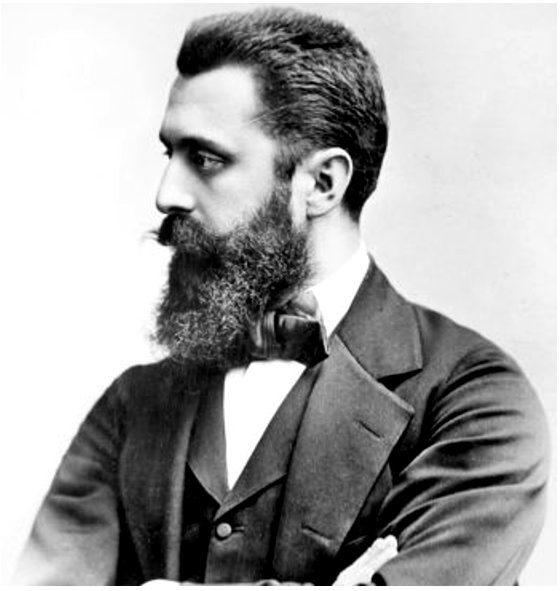
Theodor Herzl
Journalist, political activist, and founder of modern political Zionism
of 100 · unclear trend · Some good traits but inconsistent
Standing
39/100
Raw Score
37/85
Confidence
72%
Evidence
Strong
About
Herzl transformed late-19th-century antisemitic crisis into a global political program for Jewish statehood, giving persecuted Jews a rallying framework while also helping launch a colonizing project in Palestine.
The public record shows strong organizing drive, strategic persistence, and serious concern for endangered Jews, but thinner evidence of devotional life, mixed integrity signals, and major moral contestation around Palestinian displacement and colonial framing.
Five Pillars
Pillar scores (0–100%)
Herzl's public record is strongest on organized response to Jewish vulnerability and persistence under pressure, but much weaker on observable worship discipline, ordinary charity, and morally clean treatment of the peoples affected by his political program.
Goodness over time
Starts at 100 at birth, natural decay after accountability age, timeline events adjust the trajectory.
17 Criteria Scores
Individual item scores (0–5) with evidence notes
Core Worldview
Public record shows Jewish identity but political rather than devotional emphasis.
Little direct public evidence of eschatological accountability language.
Public case was framed chiefly in political terms.
He invoked Jewish peoplehood more than explicit scriptural obedience.
Public record gives only limited prophetic-model language.
Contribution to Others
Little strong public evidence beyond family and communal identification.
No strong repeated public record specific to unsupported youth.
Movement was designed in part as a remedy for Jews trapped by persecution and pogroms.
His politics centered Jews cut off from security and belonging in Europe.
He responded to public Jewish appeals but evidence is mixed and elite-mediated.
He sought national self-determination for Jews under hostile conditions.
Personal Discipline
Accessible public evidence of regular prayer is sparse.
Accessible public evidence of disciplined personal charity is sparse.
Reliability
Strong public commitment to the movement coexisted with tactical ambiguity and colonial bargaining.
Stability Under Pressure
Limited evidence of personal financial hardship; persistence is clearer than deprivation.
He kept organizing despite family strain, illness, and exhaustion.
He stayed active through political hostility and movement crisis.
Timeline
Key events and documented turning points
Paris correspondence and antisemitic backlash change his political outlook
After moving to Paris as Neue Freie Presse correspondent, Herzl concluded that antisemitism could not be solved by assimilation alone and began moving toward organized Jewish political action.
→ Personal and intellectual turning point toward political Zionism.
highPublishes The Jewish State
Herzl argued that the Jewish question should be treated as a political world question and advanced an organized state-building answer rather than private philanthropy or continued assimilation.
→ Created the foundational manifesto of political Zionism and drew wide attention from Jewish activists.
very_highConvenes the First Zionist Congress in Basel
Herzl shifted the planned congress from Munich to Basel after local Jewish opposition, then secured the Basel Program and the Zionist Organization. The program sought a legally secured Jewish home in Palestine through institution-building and the promotion of settlement there.
→ Built enduring institutions and momentum, but also fixed a colonizing program in Palestine into the movement's political architecture.
globalContinues failed charter diplomacy with imperial powers
Herzl kept pursuing state backing from the Ottoman sultan and then Britain despite repeated setbacks, showing persistence but also dependence on elite imperial sponsorship.
→ No charter was secured, but Herzl kept the movement active through diplomacy and propaganda.
highBacks the British East Africa proposal
When Britain proposed territory in East Africa as a temporary refuge, Herzl was willing to consider it. The move triggered fierce opposition inside the Zionist movement, especially from Russian delegates, and exposed the gap between emergency rescue politics and the movement's stated destination in Palestine.
→ Deepened internal distrust and left Herzl unable to settle the conflict before his death.
highDies after years of overwork while leading the movement
Herzl died at 44 after years of intense political travel, publishing, fundraising, and lobbying, before he could resolve the Uganda dispute or secure state backing.
→ Ended his personal leadership but left behind institutions and a political script that outlived him.
highPressure Tests
Behavior under crisis or scrutiny
Paris and the Dreyfus-era antisemitic climate
1891Herzl saw assimilation failing under renewed public antisemitism.
Response: He redirected his career toward organized nationalist politics.
positiveRepeated diplomatic failures with the Ottoman Empire and Britain
1901He could not secure a charter for mass Jewish settlement.
Response: He kept lobbying and organizing rather than abandoning the cause.
mixed_positive1903 Uganda dispute
1903A temporary refuge plan split the movement and triggered fierce opposition.
Response: He could not restore trust or consensus before his death.
negativeProgression
crisis years
Diplomatic setbacks, internal division, and worsening health narrowed his room to maneuver.
decliningcurrent stage
Legacy stage: globally influential, morally contested, and inseparable from the later Israeli-Palestinian conflict.
unclearearly years
Assimilated Austro-Hungarian Jewish intellectual life, journalism, literature, and law before public political activism.
forminggrowth years
Rapid escalation from diagnosis of antisemitism to transnational institution-building and manifesto politics.
improvingBehavioral Patterns
Positive
- • Turned diffuse fear and persecution into organized political action.
- • Showed unusual stamina in writing, diplomacy, and institution-building over a short life.
- • Kept a transnational focus on Jews facing exclusion and pogrom pressure.
Concerns
- • Framed Palestine through settlement and state-making without equal visible concern for Arab self-determination.
- • Willingness to pivot to imperial territorial offers exposed a pragmatic, sometimes instrumental politics.
- • Public evidence for prayer, disciplined charity, and devotional life is sparse.
Evidence Quality
5
Strong
3
Medium
0
Weak
Overall: strong
This profile evaluates public actions, commitments, and patterns. It does not judge the unseen state of a person's soul.