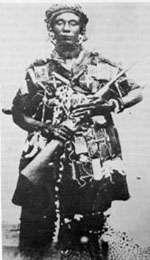
Yaa Asantewaa
Queen mother of Ejisu and anti-colonial resistance leader in the Asante Empire
of 100 · stable trend · Visibly decent and improving
Standing
56/100
Raw Score
47/85
Confidence
72%
Evidence
Medium
About
Yaa Asantewaa’s strongest evidence is public courage under colonial pressure: after British deportations destabilized Asante leadership, she helped rally resistance to Governor Frederick Hodgson’s demand for the Golden Stool and became the most enduring face of the 1900 uprising. The record is highly positive on resilience, freedom-seeking, and moral seriousness in public duty, but thinner on routine private worship, family-specific care, and some biographical details.
The observable pattern is strongly constructive in the public sphere. She accepted personal risk to defend her people from foreign domination and humiliation, stayed defiant under siege and eventual exile, and left a legacy that still anchors girls’ education and anti-colonial memory in Ghana. Confidence stays medium because several details of her life, especially her exact death year and the mechanics of her capture, vary across sources.
Five Pillars
Pillar scores (0–100%)
Yaa Asantewaa scores highest on resilience and integrity because the public record repeatedly shows steadiness, courage, and refusal under colonial pressure. Her social-care score is solid rather than elite because most evidence comes through collective defense and liberation rather than direct personal charity. Belief remains meaningfully positive because the Golden Stool crisis only makes sense inside a lived sacred order, but worship-specific observability is limited and should not be invented.
Goodness over time
Starts at 100 at birth, natural decay after accountability age, timeline events adjust the trajectory.
17 Criteria Scores
Individual item scores (0–5) with evidence notes
Core Worldview
Sacred-order language around the Golden Stool supports a cautious positive score.
Public evidence suggests moral accountability, but not a detailed afterlife doctrine.
The crisis she answered was explicitly tied to an unseen sacred order and ancestral meaning.
The surviving public record does not document scripture-like revealed guidance clearly.
There is little direct evidence about prophetic exemplars in the surviving record.
Contribution to Others
She appears to have acted protectively toward kin-linked political communities, though evidence is not richly personal.
Direct evidence is limited, though her legacy later became important to girls’ education.
Anti-colonial resistance and resistance to indemnity burdens support a moderate positive score.
The public record is thin on this specific form of outward care.
She responded to a collective call for leadership when chiefs and communities faced humiliation and danger.
Freedom from colonial domination is one of the clearest recurring themes in her record.
Personal Discipline
Routine devotional practice is not well documented in public sources.
The record does not preserve clear evidence of disciplined obligatory giving.
Reliability
Her public stance stayed aligned with her rhetoric under severe pressure.
Stability Under Pressure
Sources note farming competence and wartime scarcity, but personal-finance evidence is limited.
She endured defeat and exile without any public record of surrendering her cause.
Conflict pressure is the strongest and clearest part of the record.
Timeline
Key events and documented turning points
Assumed frontline leadership in Ejisu after British deportations
After the British deported Prempeh I and other Asante leaders, Yaa Asantewaa was left effectively in control of Ejisu and became a focal point for local resistance politics.
→ She moved from court authority into direct crisis leadership, setting the stage for later revolt.
highRejected Hodgson’s Golden Stool demand and pushed chiefs toward resistance
When Governor Frederick Hodgson demanded the Golden Stool, Yaa Asantewaa publicly rebuked hesitation among Asante leaders and framed resistance as a matter of honor, duty, and sacred trust.
→ Her intervention helped turn resentment into organized revolt.
highLed the uprising that trapped the British in the Kumasi fort
During the 1900 uprising, forces aligned with Yaa Asantewaa besieged the British position in Kumasi and turned her into the central symbol of the last major Asante war against British imperialism.
→ The revolt disrupted British control and made her the public face of anti-colonial resistance.
highShifted resistance into guerrilla warfare after British reinforcements arrived
As the British brought in reinforcements and heavier weapons, Yaa Asantewaa’s side continued the campaign through stockades and guerrilla resistance rather than immediate surrender.
→ The war lasted beyond the initial siege phase and demonstrated unusual persistence under military pressure.
highWas removed to exile in the Seychelles after the revolt was broken
Following the suppression of the revolt, Yaa Asantewaa was captured and sent into exile in the Seychelles, where she remained until her death.
→ The uprising was defeated militarily, but her public image hardened into a symbol of refusal and sacrifice.
highHer name was given to a girls’ senior high school in Ghana
Posthumously, Yaa Asantewaa’s legacy was folded into Ghanaian public education through the creation of Yaa Asantewaa Girls’ Senior High School, reflecting her continued symbolic role in girls’ ambition and civic memory.
→ Her legacy became part of state-backed educational and cultural identity rather than only war memory.
mediumPressure Tests
Behavior under crisis or scrutiny
1896 deportation crisis
1896British authorities removed key Asante leaders, leaving Ejisu and the wider confederacy politically destabilized.
Response: Yaa Asantewaa stepped into a more direct leadership role rather than withdrawing from public responsibility.
positiveGolden Stool confrontation
1900Governor Hodgson’s demand for the Golden Stool turned colonial pressure into a direct spiritual and political humiliation.
Response: She rebuked hesitation among chiefs and helped turn outrage into organized resistance.
positiveCapture and exile
1901British suppression of the revolt ended in her deportation to the Seychelles.
Response: The resistance was defeated militarily, but the public record portrays her as defiant to the end rather than compliant.
positiveProgression
crisis years
The 1900 war tested whether her courage was symbolic or real; the record points clearly to real public resolve under military pressure.
upcurrent stage
Her present-day signal is posthumous and broadly positive: she is remembered as a model of anti-colonial courage, though some biographical details remain contested.
stableearly years
Her standing as a farmer, queen mother, and adviser gave her local authority before open anti-colonial war.
upgrowth years
The 1896 deportations pushed her from court influence into direct resistance leadership.
upBehavioral Patterns
Positive
- • Repeated willingness to defend her people when more powerful men hesitated
- • Treats collective freedom and sacred trust as duties worth personal sacrifice
- • Legacy continues to animate public memory around women’s courage and national dignity
Concerns
- • Routine private worship and charity are not richly documented in the surviving record
- • Some frequently repeated biographical details rest on later retellings rather than tightly contemporary records
Evidence Quality
5
Strong
2
Medium
0
Weak
Overall: medium
This profile evaluates observable public behavior and evidence, not the state of a person's soul.