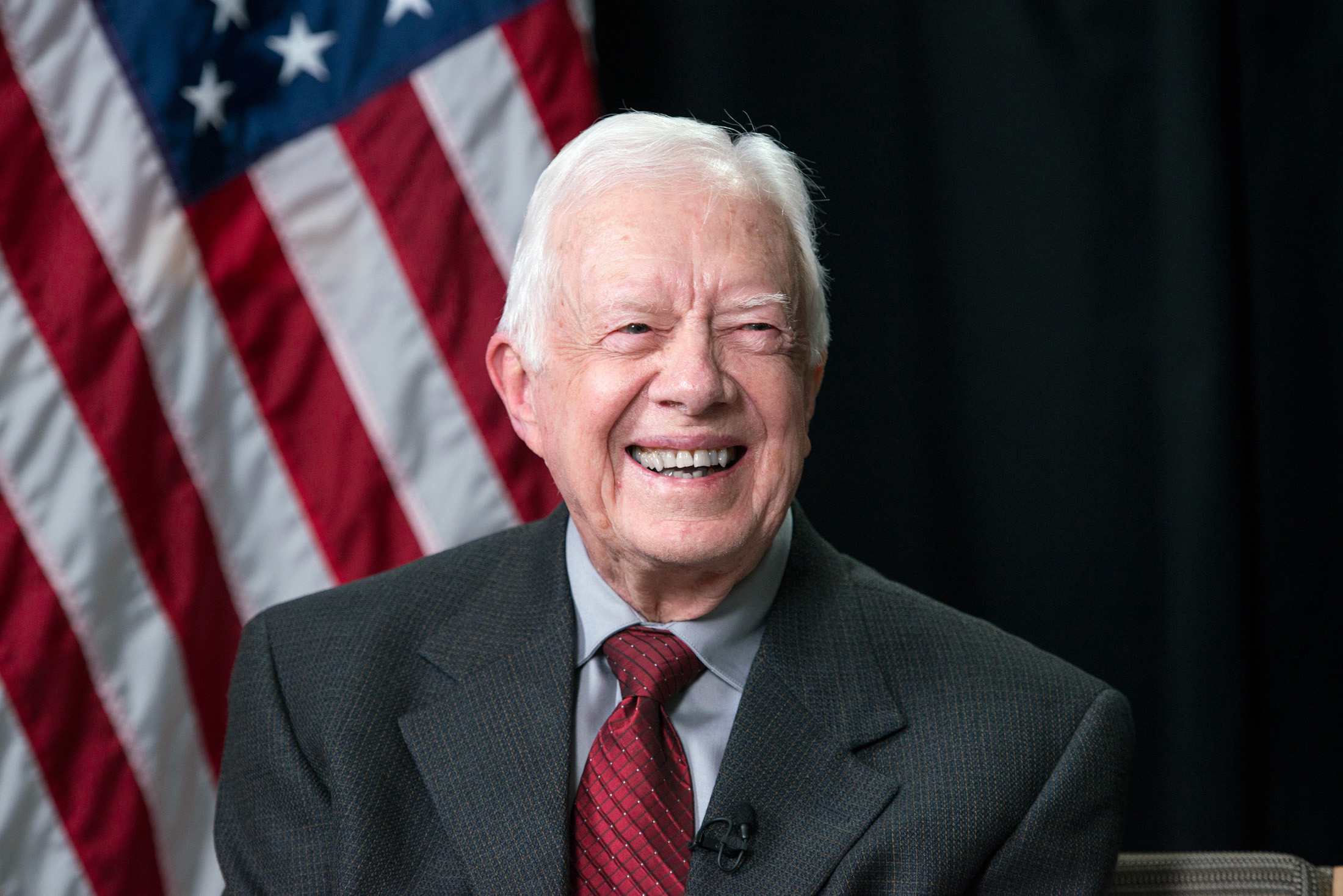
James Earl Carter Jr.
39th President of the United States, humanitarian, peace mediator, and co-founder of The Carter Center
of 100 · stable trend · Strong moral/spiritual alignment
Standing
82/100
Raw Score
70/85
Confidence
82%
Evidence
Strong with some contested interpretation
About
Jimmy Carter's public record combines explicit Christian devotion, unusual post-defeat service, and large-scale work for peace, housing, democracy, and disease eradication.
The strongest evidence points to deep belief, sustained care for vulnerable people, and resilient service long after political defeat. The main cautions are the Iran hostage crisis and failed rescue mission, economic trouble during his presidency, and an uneven human-rights record toward some allied governments.
Five Pillars
Pillar scores (0–100%)
Raw score 70 out of 85 and weighted score 82 out of 100. Carter's strongest signals come from explicit faith, decades of practical service to vulnerable people, and resilient work after political defeat. The score stays below the rare-excellence tier because his presidency included major failures and because his human-rights commitments were not uniformly applied.
Goodness over time
Starts at 100 at birth, natural decay after accountability age, timeline events adjust the trajectory.
17 Criteria Scores
Individual item scores (0–5) with evidence notes
Core Worldview
Contribution to Others
Personal Discipline
Reliability
Stability Under Pressure
Timeline
Key events and documented turning points
Signed the Torrijos-Carter treaties to transfer the Panama Canal to Panama
Carter accepted a politically costly deal to phase out direct U.S. control over the canal and recognize Panamanian sovereignty, prioritizing a long-term peaceable settlement over short-term domestic applause.
→ The treaties reduced a long-running source of grievance and set a peaceful path to full Panamanian control in 1999.
highBrokered the Camp David Accords between Egypt and Israel
Carter hosted intensive negotiations at Camp David and personally pushed the parties toward an agreement that created a framework for the Egypt-Israel peace treaty.
→ The accords led to the 1979 Egypt-Israel peace treaty and remain one of the clearest successes of his presidency.
highThe Iran hostage crisis and failed rescue mission damaged his presidency
Carter persisted in negotiations and accepted political pain rather than rush into a broader war, but the prolonged crisis and the failed rescue mission became defining failures of his term.
→ The hostages remained captive for 444 days, the rescue mission failed, and the episode became a major factor in his electoral defeat.
highReturned home after leaving office and kept a public teaching life in church
After losing reelection, Carter resumed ordinary church service in Plains and remained a visible Sunday school teacher for decades rather than disappearing into prestige-only roles.
→ The commitment reinforced that his religious identity was durable and not just campaign language.
mediumCo-founded The Carter Center for peace, democracy, and health work
Carter and Rosalynn Carter turned post-presidential life into an institutional project focused on human rights, conflict resolution, election observation, and disease prevention.
→ The Center became the main vehicle of his long post-presidential service and gave his commitments continuity beyond speeches.
highBegan the decades-long Habitat for Humanity work that made housing a signature cause
Carter and Rosalynn Carter began volunteering with Habitat near their home in Georgia and helped turn housing service into a global, repeated pattern of hands-on work.
→ Their annual work projects helped build or improve 4,447 Habitat homes and inspired more than 108,000 volunteers.
highMade Guinea worm eradication a long-horizon mission of the Carter Center
Under Carter's leadership, the Carter Center took on the eradication of Guinea worm disease, pairing patient fieldwork with decades of international cooperation on behalf of neglected communities.
→ The campaign cut annual human cases from an estimated 3.5 million in 1986 to 15 confirmed cases in 2024.
highHelped defuse the North Korea nuclear crisis as a former president
Carter entered a politically delicate situation as a private citizen and helped negotiate terms that opened the first U.S.-North Korea dialogue in four decades.
→ The 1994 breakthrough helped freeze North Korea's nuclear program for years and demonstrated real post-presidential peacemaking capacity.
highPressure Tests
Behavior under crisis or scrutiny
1980 Iran hostage crisis
1980Carter faced a prolonged diplomatic humiliation, intense media pressure, and a failed rescue attempt that killed U.S. service members.
Response: He kept trying negotiations, accepted political cost, and avoided a wider war, but the result still counts as a major failure under pressure.
mixed1980 electoral defeat
1980He lost reelection badly after a turbulent term.
Response: Instead of withdrawing into bitterness, he built decades of concrete service through The Carter Center, church teaching, and Habitat for Humanity.
positive2015 cancer diagnosis and late-life frailty
2015Carter faced cancer, advanced age, and later hospice care after a very public life.
Response: He continued appearing publicly for a time, kept his service identity intact, and faced decline in a way widely remembered as calm and faithful.
positiveProgression
crisis years
Converted defeat into an unusually durable life of service, mediation, and institution-building.
upcurrent stage
Late-life witness centered humility, church commitment, and persistence rather than reinvention.
stableearly years
From rural Georgia discipline and naval training into local public leadership.
upgrowth years
Showed real moral ambition and diplomatic courage, but with mixed execution and serious pressure failures.
mixedBehavioral Patterns
Positive
- • Turned post-office life into repeated, embodied service rather than paid prestige alone.
- • Linked stated Christian belief to practical work for peace, housing, health, and dignity.
- • Accepted electoral loss and personal suffering without abandoning public usefulness.
Concerns
- • His single presidential term contained serious execution failures, especially around Iran and the economy.
- • Human-rights principle was real but inconsistently applied to some authoritarian allies.
- • Public evidence is far stronger on large public service than on direct family or household-level giving practices.
Evidence Quality
12
Strong
4
Medium
0
Weak
Overall: strong_with_some_contested_interpretation
This profile evaluates observable conduct and public evidence, not the unseen state of a person's soul.