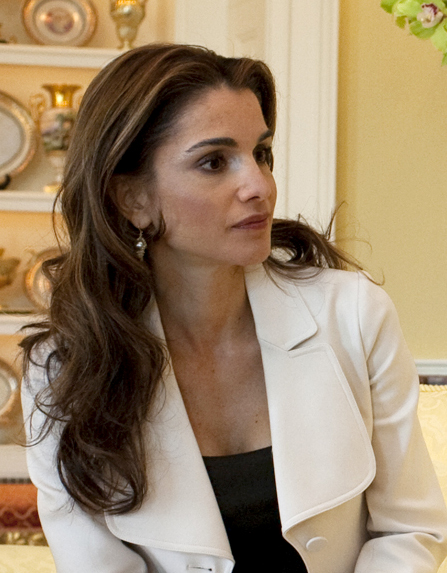
Rania Al Abdullah
Queen consort of Jordan and global education and refugee advocate
of 100 · stable trend · Strong moral/spiritual alignment
Standing
78/100
Raw Score
67/85
Confidence
68%
Evidence
Strong
About
Queen Rania has built a long public record of education reform, orphan support, and refugee advocacy, especially for children and girls, while remaining exposed to criticism tied to Jordanian royal politics and elite privilege.
Her observable pattern is consistently outward-facing and service-oriented, with unusually durable attention to vulnerable children, refugees, and neglected schools. The main caution is that some public goodwill rests on palace-backed initiatives and official narratives, while corruption criticisms around the monarchy have been serious enough to keep the profile under review.
Five Pillars
Pillar scores (0–100%)
Queen Rania scores highest where the public record is thickest: sustained social care through education, orphan support, and refugee advocacy. The score stays below rare excellence because the evidence base is thinner on private worship observance, family-specific obligations, and because integrity concerns around royal privilege remain part of the public record.
Goodness over time
Starts at 100 at birth, natural decay after accountability age, timeline events adjust the trajectory.
17 Criteria Scores
Individual item scores (0–5) with evidence notes
Core Worldview
Public record clearly identifies her as Muslim; no meaningful contrary evidence found.
Muslim assumption-of-best rule applied; no contrary evidence found.
Muslim assumption-of-best rule applied; no contrary evidence found.
Muslim assumption-of-best rule applied; no contrary evidence found.
Muslim assumption-of-best rule applied; no contrary evidence found.
Contribution to Others
Child and family protection work is visible, but evidence is broader than kin-specific.
Al-Aman Fund is a durable orphan-support institution with recent follow-through.
Education and vulnerable-youth initiatives repeatedly target people with structural disadvantage.
Refugee advocacy and camp visits show recurring concern for displaced people.
Public engagement with vulnerable groups is clear, though direct person-to-person ask evidence is thinner.
She supports empowerment and education, but direct evidence on freeing people from coercive constraint is modest.
Personal Discipline
Muslim assumption-of-best rule applied; ordinary privacy around worship is not negative evidence.
Muslim assumption-of-best rule applied and public charitable infrastructure is strong.
Reliability
Long-running follow-through helps, but monarchy-linked corruption criticism keeps this at mixed-positive rather than strong.
Stability Under Pressure
Public evidence on financial hardship is thin rather than clearly negative.
Public evidence on personal hardship is limited.
Refugee and Gaza advocacy show steadiness in difficult conflict settings.
Timeline
Key events and documented turning points
Became Queen of Jordan and entered a sustained public role centered on social development
When Abdullah II became king, Rania assumed a national platform that she used to emphasize education, women's advancement, child welfare, and cross-cultural understanding.
→ Created the long-term public responsibility platform from which her education and child-welfare agenda operated.
mediumEstablished Al-Aman Fund to support older orphans aging out of care
Al-Aman Fund was created to finance higher education and support services for orphaned youth after they leave formal care, targeting a gap many institutions ignored.
→ Built an enduring mechanism for scholarships, counseling, housing, and transition support for orphaned youth.
highLaunched Madrasati to improve neglected public schools
Madrasati linked public, private, and civil-society partners to improve school environments in underperforming Jordanian public schools.
→ Turned education support into a long-running partnership model rather than a single symbolic campaign.
highFaced public accusations of corruption during Jordanian unrest
Leaders from major Bedouin tribes publicly accused Queen Rania of corruption during a period of wider dissatisfaction with the Jordanian monarchy. The accusation itself was newsworthy, but the public record in accessible reporting remains clearer on the charge than on any proven finding against her.
→ Created a durable integrity caution around palace privilege and public perception, without yielding a comparably clear public evidentiary record of proven misconduct.
mediumUsed an international UN platform to press for refugee protection
At the UN Summit for Refugees and Migrants, Queen Rania tied Jordan's own burden-sharing to a broader moral case for refugee protection and institutional compassion.
→ Reinforced a repeated pattern of public advocacy for displaced people beyond Jordan's borders.
highShowed long-horizon follow-through on orphan support through Al-Aman Fund
In 2024 she revisited Al-Aman beneficiaries and highlighted a program that her office said had reached 4,866 youth, including scholarships, housing, health insurance, and job-readiness support.
→ Strengthened the case that her orphan-focused work is sustained over time rather than a short-lived royal initiative.
highTook a high-visibility stance on Gaza under intense geopolitical pressure
In major U.S. media appearances, Queen Rania criticized the conduct of the Gaza war, argued for humanitarian accountability, and explicitly condemned antisemitism while defending civilian rights.
→ Showed willingness to keep speaking in a polarizing conflict environment, though the issue also increases political contestation around her public role.
highPressure Tests
Behavior under crisis or scrutiny
2011 corruption accusations during domestic unrest
2011Queen Rania became a named target in a period of public anger toward the monarchy, with tribal leaders accusing her of corruption.
Response: The accessible public record searched here is clearer on the accusation and the political context than on a direct public accountability process led by her.
mixed2016 refugee crisis advocacy
2016She used a high-profile UN platform to argue that refugees should be met with responsibility rather than abandonment.
Response: Her response showed public steadiness and moral framing under a difficult regional burden-sharing debate.
positive2024 Gaza media appearances
2024She spoke forcefully in U.S. media about civilian suffering in Gaza during an intensely polarized war.
Response: She stayed publicly engaged, condemned antisemitism, and kept the focus on humanitarian law and civilian dignity.
positiveProgression
crisis years
Faced reputational pressure during Jordanian unrest while keeping a humanitarian-facing agenda.
mixedcurrent stage
Remains a globally visible humanitarian and education advocate with stable themes and live political sensitivities.
steadyearly years
Transitioned from private-sector work into public life with a focus on social development.
upwardgrowth years
Built institutions around education, teacher development, and orphan support.
upwardBehavioral Patterns
Positive
- • Turns public prominence into sustained education and child-welfare initiatives.
- • Keeps vulnerable children, refugees, and orphans central to her messaging over many years.
- • Shows durable public communication discipline in cross-cultural and humanitarian advocacy.
Concerns
- • Integrity judgments are limited by contested corruption allegations linked to the monarchy.
- • Official and palace-affiliated sources dominate some of the positive evidence base.
- • Public evidence is weaker on private devotional discipline than on institutional advocacy.
Evidence Quality
7
Strong
1
Medium
0
Weak
Overall: strong
This profile measures observable public behavior and evidence, not hidden intention, private faith, or salvation.